
A building from the 1970s with collective gas heating, rising charges every winter, and a general assembly where no one knows where to start the work: this is the concrete starting point of an energy diagnosis in a co-ownership. Since January 1, 2026, all co-ownerships with 50 lots or fewer are subject to the obligation of a collective energy performance diagnosis (DPE). We are no longer talking about a process reserved for large complexes.
What the obligation of the collective DPE changes for small co-ownerships
Until recently, modest co-ownerships flew under the radar. The regulatory timeline has caught up with everyone: since January 1, 2024, for buildings with more than 200 lots, since January 1, 2025, for those between 50 and 200 lots, and since January 1, 2026, for co-ownerships with 50 lots or fewer.
In practice, this means that the property manager must include the collective DPE on the agenda of the general assembly if it has not yet been carried out. This diagnosis, valid for 10 years, assesses the energy consumption and greenhouse gas emissions of the building as a whole. It does not replace the individual DPE for each housing unit, but it provides an overall picture of the building’s performance.
For co-owners considering consulting the co-ownership diagnosis on Place A, the role of the property manager in this process is a point not to be underestimated: it is the manager who commissions the certified diagnostician and who transmits the results to the council.
An operational detail that many small co-ownerships discover late: the collective DPE has become a prerequisite before launching a multi-year work plan or applying for certain energy renovation aids. Without this document, the co-ownership finds itself blocked in its financing process.

Collective DPE, energy audit, and DTG: choosing the right tool according to the situation
These three diagnostics are often confused. Their scope and depth of analysis differ significantly, and the choice depends on what the co-ownership is looking to achieve concretely.
- The collective DPE classifies the building on a scale from A to G. It provides an overview of energy performance but does not offer quantified work scenarios. It is the minimum regulatory requirement.
- The energy audit goes further: it identifies areas of energy loss (roof, facade, joinery, heating) and prioritizes the work to be undertaken. It includes concrete proposals with an estimate of the impact on consumption.
- The global technical diagnosis (DTG) encompasses the condition of the building in a broad sense, not just energy. It integrates the structure, networks, and common areas. It is often encountered in co-ownerships preparing an ambitious multi-year work plan.
For a building classified F or G, limiting oneself to the collective DPE is like taking a temperature without making a medical diagnosis. The energy audit then becomes the centerpiece because it allows prioritizing work based on their cost-effectiveness.
Multi-year work plan: the direct link between diagnosis and action
The PPPT (project of a multi-year work plan) is now mandatory for almost all residential co-ownerships. It is the document that translates the results of the diagnosis into a concrete program spread over several years.
On the ground, it is observed that co-ownerships that carry out the collective DPE without quickly following up with a PPPT waste time. The diagnosis alone triggers nothing: the council must take it up to propose a work schedule at the general assembly.
What the PPPT must contain
The plan lists the necessary work for the preservation of the building, the health and safety of the occupants, and energy renovation. It is accompanied by a budget estimate and a timeline.
The PPPT obliges the co-ownership to set aside a work fund, which avoids the classic scenario where the assembly votes for work without having established the necessary treasury. Feedback on this point varies according to the size of the co-ownerships, but the provisioning mechanism remains the same.
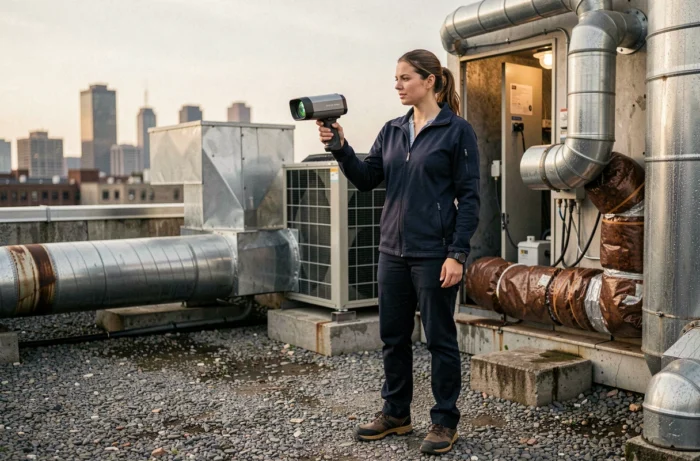
Obtaining a reliable energy diagnosis: concrete points of vigilance
The quality of a collective DPE or an audit largely depends on the professional who carries it out. We have all seen rushed diagnostics where the diagnostician did not even visit the attic or the boiler room.
Criteria for selecting the diagnostician
The diagnostician must be certified and covered by professional liability insurance. For an energy audit, a thermal study office or a specialized architect is called upon. In both cases, requesting references on buildings of similar typology helps avoid unpleasant surprises.
A point often overlooked: the diagnostician needs access to the building’s energy bills, plans, and ideally consumption data over several years. The more complete the data provided, the more usable the result will be.
Common pitfalls to avoid
Some co-ownerships have a collective DPE carried out to comply, then file the report without follow-up. The diagnosis is only valuable if it informs a decision: to launch a complementary audit, vote for a PPPT, or undertake work on a specific item such as roof insulation.
Another pitfall: confusing the collective DPE with the individual DPEs of the lots. The collective DPE does not exempt each co-owner from carrying out their own DPE in case of sale or rental. The two documents coexist and respond to distinct obligations.
Energy renovation in co-ownership works like a chain: diagnosis, planning, financing, work. Skipping a step weakens the entire process. The collective DPE opens this chain, the PPPT structures it, and the work materializes it. For co-ownerships that are just entering the system, the immediate priority remains to appoint a competent diagnostician and to plan for the inclusion of the topic in the next general assembly.