This year’s fashion is built around a technical paradox: runways showcase generous volumes and saturated colors, while the European and French regulatory framework tightens constraints on textile production. Understanding these two dynamics allows for clothing choices that are both current and sustainable.
Textile Regulation and Fashion: What Changes for Your Purchases
The legal context directly modifies the available offerings in stores. The French law n° 2026-602 of July 8, 2026, creates the legal category of ultra fast fashion and applies a progressive penalty per item. This additional cost starts between 0.25 and 12 euros this year, then will increase each year up to 20 euros per piece starting in 2030.
As of January 1, 2027, any advertising for these brands will be prohibited, including through influencers, under penalty of fines that can reach 100,000 euros. In practical terms, very low-priced items will be less visible and more expensive.
On the European side, the ESPR regulation (Regulation (EU) 2024/1781) prohibits large textile companies from destroying their unsold goods since July 19, 2026. Brands must prioritize reuse, donation, or recycling. A digital product passport, in the form of a QR code integrated into the garment, will be mandatory starting in 2027 to provide information on the composition, origin, and environmental impact of each piece.
These two regulations steer collections toward pieces designed to last. Brands that offer fast-fashion clothing are losing visibility and price competitiveness, pushing the entire market toward more streamlined and well-constructed wardrobes. For those looking to follow current trends while comparing offers, it is useful to learn more about Shop Mania before finalizing purchases.
Trendy Colors: The Return of Saturated Hues and Structuring Black
The autumn-winter collections highlight a palette that oscillates between two poles. On one side, bright and bold colors, inherited from the movement that the runways have dubbed “over the rainbow.” On the other, an omnipresent black, worn in total looks or used as a base to balance a strong piece.
Butter yellow, already seen in spring, continues in thick knits and structured coats. Deep reds and electric blues are gaining ground in accessories as well as main pieces.
Combining Colors Without Overloading the Silhouette
The most reliable rule remains to limit the outfit to a maximum of two strong colors. A third neutral shade (black, off-white, heather gray) prevents the ensemble from tipping into accumulation. Wearing butter yellow pants with a black sweater and white shoes works better than mixing three saturated shades.
Floral prints, very present this season under the label “flower power,” are preferably worn on a single piece, with the rest of the outfit remaining solid. This principle of visual balance transcends all seasons and does not depend on a passing trend.
Volumes and Cuts: The Barrel Jean and Oversized Silhouette
The barrel cut, characterized by rounded hips and a tapered hem, is establishing itself as the reference denim silhouette. It is gradually replacing the classic straight jean in women’s and unisex wardrobes.
Oversized is no longer limited to sweaters. Short jackets with dropped shoulders, cropped trench coats, and loose blousons form a vocabulary of volumes that structure the look without stiffening it. The technical key is contrast:
- An oversized top works with a fitted bottom (skinny jeans, straight skirt) to maintain a clear reading of the silhouette
- A wide barrel-type pant requires a top that is closer to the body, a fine turtleneck or a tucked-in t-shirt
- Layering gains readability when each layer has a different length, avoiding the block effect

The Belt as a Structuring Tool
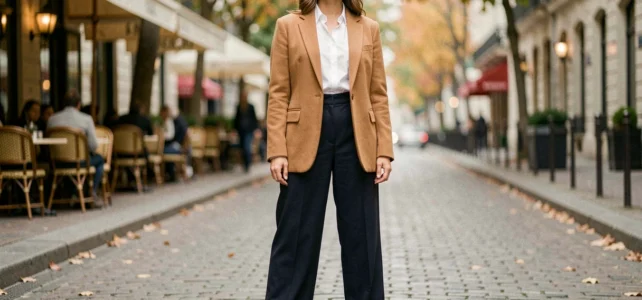
On a loose silhouette, the belt marks a visual reference point. Worn over a long coat, an oversized blazer, or even a thick sweater, it redefines the waist without sacrificing volume. Wide leather models offer an interesting material contrast with fluid textiles.
Building a Sustainable Look with Versatile Pieces
The underlying trend, amplified by the regulatory framework, pushes towards a wardrobe composed of pieces that can be combined across several seasons. Rather than following every micro-trend, the principle of a capsule wardrobe adapted to trends consists of integrating one or two strong pieces each season into a stable base.
For this year, a list of highly versatile pieces emerges:
- A raw barrel jean, wearable with sneakers as well as with heeled ankle boots
- A short colored jacket that replaces the classic blazer in spring and layers under a coat in winter
- A large silk scarf, usable as a head accessory, tied to a bag, or worn as a belt
- An oversized thick-knit sweater in a neutral color, compatible with all pieces in the wardrobe
This foundation allows for absorbing seasonal variations without multiplying purchases. The scarf, for example, transcends seasons and styles: worn tied around the neck with a white t-shirt in summer, it slips under a coat collar in autumn.
Materials and Durability: Reading Labels Differently
The textile digital passport, expected by 2027, will generalize access to information on composition and traceability. In the meantime, prioritizing natural fibers (cotton, linen, wool) with a sufficiently dense weight ensures better longevity. Synthetic blends with more than half polyester lose their shape faster and do not withstand repeated washes well.
This year’s fashion trend can be summed up in a fairly simple technical principle: assertive volumes, strong colors carefully balanced, and pieces chosen for their longevity. The regulatory framework makes this approach not only desirable but economically logical, as fast fashion items will gradually become more expensive without offering corresponding durability.