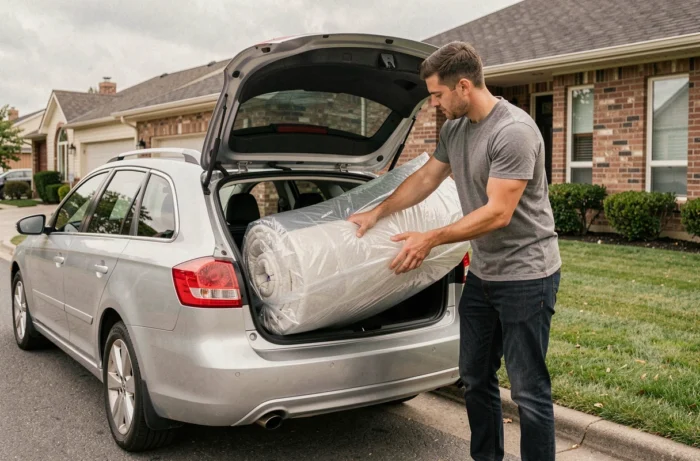
A vacuum-packed mattress fits into a compact box, but sliding it into a car trunk requires a bit of technique. Between the weight of the package, the actual available space, and the safety of the load, a few precautions can prevent damage to the mattress or driving in risky conditions.
Payload and section F.2: what the trunk doesn’t tell you
Before measuring the trunk, check a point that most guides overlook: the payload of your vehicle. The trunk volume may accommodate the box, but the total authorized weight includes passengers, fuel, and the mattress.
The limit to respect is found in section F.2 of the registration certificate. It indicates the maximum load weight. Subtract the empty weight of the vehicle (section G.1) and that of the occupants to obtain the actual margin. A rolled foam mattress weighs less than a pocket spring mattress, but the packaging box adds a few extra kilos.
Exceeding this limit can lead to the vehicle being immobilized during a check. If you are traveling with two people and luggage, the margin decreases quickly. To better understand the constraints related to transporting a rolled mattress with Idylle Habitat, section F.2 should be your first reflex.

Rolled mattress in its box or already unpacked mattress: two different situations
A mattress still packed vacuum-sealed in its original box is much easier to handle. The compact cylinder often stands upright or diagonally in a sedan trunk, and the box protects the compression cover from friction.
An already unpacked mattress cannot be re-rolled at home. The initial compression is done in the factory with an industrial machine. Trying to fold it or force it into a bag risks damaging the internal structure, especially on a pocket spring model.
For a mattress that has already been used, the only realistic option in the car is to fold down the back seat flat and slide the mattress horizontally. Check that the interior length (trunk plus cabin, seats folded) exceeds that of the mattress. In many compact vehicles, a standard-sized mattress does not fit without extending out of the trunk.
When the ski hatch can help
Some sedans and station wagons have a ski hatch between the trunk and the cabin. It allows you to let a long object stick out without fully folding down the back seat. For a rolled mattress in its box, this opening is sometimes enough to wedge the cylinder diagonally, one end in the trunk and the other slipped through the hatch.
This solution only works if the diameter of the roll fits through the opening. Measure before loading.
Securing the mattress during transport: load safety
Placing the mattress in the trunk without securing it creates a real risk. During sudden braking, any unsecured object becomes a projectile towards the front of the cabin.
A separation net or a restraint device limits the risk of projection. If your vehicle is not equipped with one from the factory, universal nets can be attached to the headrests of the front seats or to the anchorage points in the trunk.
A few simple rules for stable loading:
- Place the mattress as low as possible in the trunk, against the folded seatbacks, to lower the vehicle’s center of gravity.
- Wedge the box with bags or blankets to prevent it from sliding laterally in turns.
- Do not place anything heavy on the rolled mattress: the point pressure on the compression cover can puncture it and trigger the mattress inflation during transport.
- Ensure that the load does not obstruct the rear window. Driving without rear visibility is not prohibited in itself if the exterior mirrors are present, but it complicates maneuvers significantly.

Temperature and recovery time after transport
You may have noticed that some mattresses delivered in winter take longer to regain their shape. This is not a defect. The cold slows down the decompression of the foam, especially on memory foam models.
Manufacturers generally announce a full recovery between 24 and 72 hours. In practice, a mattress transported in a non-heated trunk in cold weather may require a longer time. The most effective precaution is to unpack the mattress in a temperate and ventilated room, not in a cold garage or basement.
Prolonged vacuum storage: an aggravating factor
A rolled mattress purchased in-store and transported the same day regains its shape without difficulty. A mattress that has remained compressed for several months (end of stock, second-hand purchase) takes longer to regain its nominal thickness. Unpack the mattress as soon as you arrive at your destination to start the recovery process as early as possible.
Protective cover for car transport
Even vacuum-sealed in its box, a rolled mattress can suffer friction against the walls of the trunk, anchoring hooks, or metal edges. A thick plastic transport cover (sold in bedding or moving stores) wraps the box and limits snags.
For an already unpacked mattress, the cover becomes necessary. It protects the fabric from moisture in the trunk, dust, and dirt. Secure it with wide adhesive tape to keep it in place during handling.
- Thick plastic cover: barrier against moisture and tears.
- Thick blankets as an alternative: adequate mechanical protection, but not waterproof.
- Wide adhesive tape: keeps the cover or blankets in place, to be removed carefully to avoid tearing the mattress fabric.
Transporting a rolled mattress in a car boils down to three checks: the vehicle’s payload, the stability of the load, and the temperature conditions during unpacking. An intact original box simplifies the entire process. For an already unpacked mattress, the task is more cumbersome, and a utility vehicle or station wagon often remains the best option.