
A machine tool that breaks down during production, a utility vehicle to be replaced before the peak season, a packaging line to be modernized to meet a new client’s needs: in each of these cases, the question of financing arises even before the technical choice. It is observed in the field that the way financing for equipment is structured weighs as much on the project’s profitability as the equipment itself.
Tax impact of the 2026 finance law on industrial equipment
Since February 2026, the rules have changed for companies investing in robotics or additive manufacturing. The finance law for 2026 (law no. 2026-103 of February 19, 2026, art. 17) has eliminated the exceptional depreciation regimes applicable to industrial robots and industrial 3D printers. In practical terms, it is no longer possible to compress the depreciation period of these assets to reduce taxes in the early years.
This change alters the net profitability of any modernization plan incorporating these technologies. A project that seemed viable with accelerated depreciation may now show a slower return on investment, thus putting more pressure on short-term cash flow.
At the same time, the super-depreciation mechanisms remain active for investments in green equipment (low-emission vehicles, equipment meeting strict environmental criteria), with additional deductions ranging from 40 to 60% of the asset’s value depending on the nature of the good. Therefore, it is advisable to check, before preparing a file, whether the targeted equipment falls into a category still eligible for a tax advantage.
The choice of a financing solution for equipment for businesses must incorporate this new fiscal reality from the estimation phase, not after signing.

Bank credit, leasing, or factoring: choose according to the real context
The classic bank loan is often contrasted with leasing as if they were interchangeable products. In practice, they do not meet the same constraints.
Bank loan for equipment
The classic credit is suitable when one wants to become an owner immediately and the company has a solid balance sheet. Banks have become more selective: they require rigorous solvency ratios and precisely documented files. An imprecise quote or an incomplete business plan is enough to have a request rejected.
Leasing
Leasing preserves cash flow by spreading the expense over the equipment’s usage period. No capital is tied up, and the asset does not appear on the balance sheet in the same way. For a growing SME that needs to maintain liquidity for its ongoing operations, it is often the most pragmatic solution.
Factoring for indirect financing
When cash flow needs are related to customer receivables that are slow to come in, factoring allows for quick cash release by selling invoices. This is not strictly equipment financing, but we see companies combining factoring and leasing to maintain their investment capacity without increasing their bank debt.
Feedback varies on the best arrangement depending on the sectors, but one rule holds in all cases: simulate the total cost over the actual usage period, not just compare monthly payments.
Building a solid financing file
The increased selectivity of banks in 2026 requires structuring the file as a technical argument, not just a simple administrative request.
- Provide detailed quotes with precise technical specifications of the equipment, delivery times, and commissioning costs. A vague quote makes the financier doubt the project’s maturity.
- Prepare a business plan that quantifies the expected productivity gain or additional revenue from the equipment. We do not finance equipment; we finance a growth project.
- Anticipate questions about repayment capacity by presenting cash flow forecasts consistent with historical accounting. Unexplained discrepancies between forecasts and actuals from previous years are a negative signal.
- Document fallback solutions: if the equipment does not generate the expected return, how does the company absorb the payments?
A complete file reduces processing times and increases the negotiation margin on financing conditions (rates, duration, repayment deferral).
Balancing modernization and over-equipping
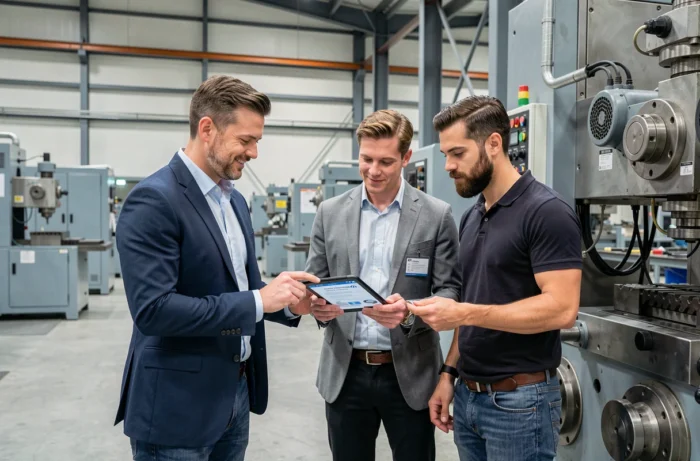
We regularly observe companies investing in oversized equipment compared to their actual order book. A five-axis machining center is of no interest if production remains limited to simple parts. The cost of maintenance, training, and financial immobilization then far exceeds the operational gain.
Before financing, it is beneficial to accurately map the expected utilization rate of the equipment over the first two years. If this rate remains below a profitable threshold, occasional renting or using an equipped subcontractor may prove more relevant than a purchase financed over five years.
The most profitable equipment is the one that is operational, not the one with the best technical specifications. Cross-referencing the actual workload with the financing plan avoids turning a growth lever into a fixed cost that is difficult to absorb.
Financing equipment for businesses is not just about finding a lender. It is a balancing act between taxation, balance sheet structure, repayment capacity, and operational reality. The elimination of exceptional depreciation for robots and additive manufacturing pushes for recalculating projects that would have been approved blindly just a year ago. The challenge remains to adapt, file by file.