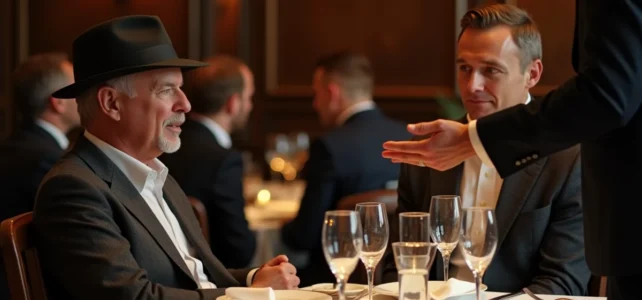
You arrive at the restaurant wearing a hat or a Panama, you sit down, and the question arises even before you unfold the napkin: should you take off your hat now or can you keep it on during the meal? The answer depends on the type of headgear, the context, and, above all, who is wearing it. Knowing how to manage your hat at the table avoids the pointed looks from fellow diners and the silent faux pas that can dampen a dinner.
Hat at the table: the man-woman rule that no one applies the same way
The classic code can be summed up in one sentence: men always remove their headgear indoors, while women enjoy a broader tolerance. A man entering a restaurant, a friend’s house, or a reception hall is expected to leave his hat or cap at the coat check before sitting down. This gesture dates back to the Middle Ages when knights removed their helmets to signal peaceful intentions toward their hosts.
For women, tradition distinguishes decorative hats (bibi, wide-brimmed, ceremonial hats) from functional hats (caps, bucket hats, beanies). A bibi worn during lunch or a cocktail can remain on the head, even at the table.
On the other hand, a sports cap or a wool beanie falls under utilitarian headgear: it should be removed just like a man’s hat. Knowing when to take off your hat at the table thus relies less on gender and more on the nature of the accessory worn.
This man-woman distinction seems outdated, and opinions on this point vary among different circles. In a casual dinner among friends, the tolerance is greater. During a formal meal with guests you know little about, it is better to apply the strict version to avoid any misunderstanding.

Removing your hat at the restaurant: the three moments not to miss
Rather than memorizing an abstract list of etiquette, one can reason through concrete moments. Three situations clearly require uncovering.
Upon entering the venue
The hat is removed before sitting at the table, not after the napkin is unfolded. It should be placed at the coat check, on a coat rack, or, if none are available, on an empty chair next to you. Placing a hat on the table, next to the plate or the bread, remains a common faux pas: it clutters the space and hinders service.
During the meal, if it was forgotten
Sometimes one might mechanically keep their cap on the terrace and then move inside when a table becomes available. The correct reflex: remove the headgear as soon as you pass through the door, even in the middle of a conversation. Waiting until the end of the course to take it off draws more attention than the discreet act of placing it on your lap.
During a toast or speech
When someone stands up to make a toast, the diners still wearing hats remove their headgear out of respect for the speaker. This gesture also applies during the national anthem in an official context, such as a gala dinner or a protocol reception.
Cap, Panama, bucket hat: each headgear has its uses at the table
We often treat “the hat” as a single category, while the codes vary according to the model worn.
- Sports cap or bucket hat: always removed indoors and at the table, regardless of the person’s gender or age. These headgear are associated with the outdoors and physical activity, not with meals.
- Felt, trilby, Panama: removed by men as soon as they enter an enclosed space. A woman wearing a wide Panama can keep it on during a terrace lunch but should remove it for an indoor dinner.
- Bibi, fascinator, ceremonial hat: considered fashion accessories on par with jewelry. They can be kept on during lunch or a cocktail, but the rule dictates that they be removed for a seated dinner.
- Religious headgear (kippah, turban, hijab): they are exempt from the removal rule. Etiquette conventions do not apply to signs related to religious practice.

Keeping your hat on at work: what labor law says in France
The subject goes beyond the private sphere. In the company cafeteria or during a professional meal, can an employer require the removal of headgear? The answer is not a simple “yes.”
Article L1121-1 of the Labor Code establishes the principle of employee dress freedom. Any restriction, including the prohibition of a cap or hat, must be justified by the nature of the task or a safety imperative, and remain proportionate to the intended purpose. An employer can no longer invoke “good manners” as the sole reason for prohibiting headgear in the cafeteria.
In practice, jobs in direct contact with customers (restaurant, hospitality, reception) may impose a dress code that includes the removal of hats. For a position without customer contact, the prohibition will be harder to justify. This recent legal framework changes the game for corporate meals: politeness is no longer enough; an objective reason is required.
Where to place your hat when there is no coat check
The most common situation at a restaurant or at friends’ homes: no coat check, no visible coat rack. You find yourself holding a felt hat with a table already set between the plate, water and wine glasses, bread on the left, and cutlery.
The most discreet solution is to place the hat on your lap, crown side up to avoid crushing its shape. If there is an empty chair next to you, you can place the hat there, also crown side up. Some restaurants offer hooks under the bar or under the table, which solves the problem.
Never place a hat on the dining table, even between courses. It takes the place of a guest, obstructs the passage of plates, and sends a signal of carelessness to the host. On the floor, it’s worse: it risks getting damaged and gives the impression that you don’t care.
Ultimately, the principle of wearing a hat at the table is simple: remove it early, store it properly, and forget about it during the meal. Customs evolve, labor law reshapes certain obligations, but the act of uncovering oneself in front of one’s hosts retains its primary function: to signal that you are fully present at the dinner, attentive to the people around the table rather than to your own style.