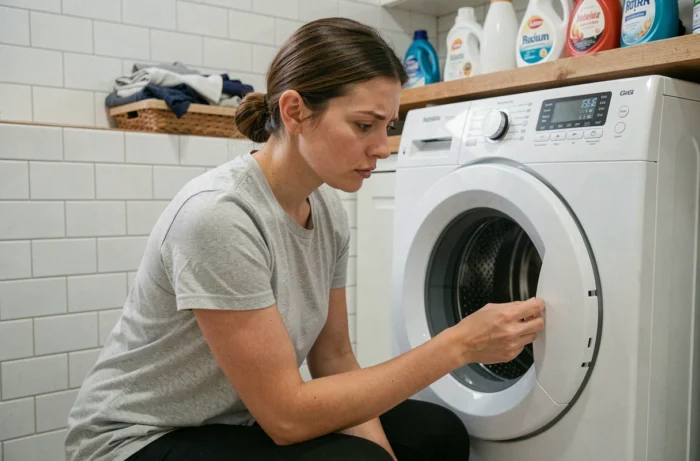
The pictograms printed on the control panel or drawer of a washing machine do not all follow the same logic. Part of them adheres to the international standard ISO 3758, coordinated by the GINETEX organization, while the other part pertains to the machine manufacturer (Whirlpool, Bosch, Siemens, Bellavita, Valberg). Confusing the two systems can lead to errors in program selection, temperature, or spin cycles, with direct consequences on the durability of textiles.
ISO 3758 Standard and Manufacturer Pictograms: Two Systems on the Same Machine
The symbols found on clothing labels stem from the NF EN ISO 3758 standard. They are divided into five identifiable families based on a basic shape: the tub for washing, the triangle for bleaching, the square for drying, the iron for ironing, and the circle for professional cleaning. A symbol crossed with a line always indicates a prohibition.
The pictograms displayed on the machine’s control panel, however, are specific to each manufacturer. A snowflake, a feather, a stylized pair of pants, or a ball of yarn denote specific programs whose names and icons vary from one brand to another. No international standard harmonizes these manufacturer visuals.
The confusion arises precisely from this coexistence. A user reads the label on their garment (ISO standard), then looks for the corresponding program on their machine (manufacturer pictogram), often without realizing they are switching from one reference system to another. To understand washing machine symbols, one must first identify which of the two systems is being referenced.
Washing Drawer Symbols: Compartments I, II, and Clover
The washing machine drawer typically has three compartments, each marked with a distinct symbol. The Roman numeral I corresponds to the pre-wash, intended for heavily soiled laundry. The Roman numeral II receives the detergent for the main cycle. The third compartment, identifiable by a pictogram in the shape of a clover (or flower depending on the brands), is reserved for fabric softener.
Pouring detergent into the wrong compartment does not trigger an alert. The product will simply be injected at the wrong time during the cycle, which reduces washing efficiency or dilutes the softener too early. On some Whirlpool or Valberg models, the pre-wash compartment is smaller than the main compartment, which serves as a useful visual cue when the markings have faded.
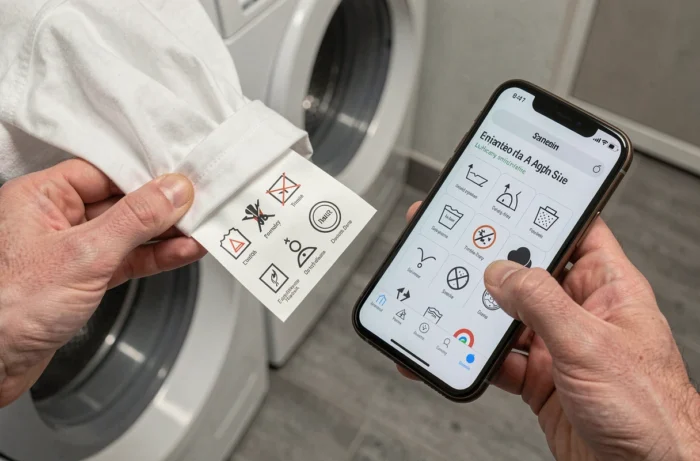
Washing Symbols on the Textile Label: Tub, Temperature, and Lines
The tub filled with water is the central pictogram for washing. The number inside indicates the maximum allowed temperature (30, 40, 60, or 90 °C). A horizontal line under the tub indicates a moderate program (synthetics). Two lines impose a very delicate cycle (wool, silk). A hand in the tub restricts washing to hand wash only.
The lines under the tub are the detail most often overlooked. They limit not only the mechanical action (drum speed) but also the spin cycle. A garment marked with two lines should not undergo a spin cycle exceeding a low speed, lest the fibers become distorted.
- Tub with number only: normal wash at the indicated temperature, standard spin allowed.
- Tub with one line: synthetic program, moderate spin recommended.
- Tub with two lines: delicate program like wool, reduced or no spin.
- Tub crossed out: machine washing prohibited, professional or hand cleaning only.
Recent Labels and Developments in the ISO 3758 Standard
Online guides often reproduce tables of symbols that have been fixed for years. The reality is more nuanced. The ISO 3758 standard has undergone recent updates, particularly regarding combinations of symbols for professional wet cleaning (W symbol in a circle). Recently purchased garments may display slightly different combinations of pictograms from those visible on older textiles, even though the five basic shapes remain the same.
The temperature markers for ironing have also evolved. Older articles consistently mention the thresholds of 110, 150, and 200 °C associated with the points on the iron. Field reports vary on this point: some recent irons and labels no longer correspond exactly to these historical thresholds.
Another rarely addressed angle concerns the legal status of pictograms in Europe. No European text generally mandates the presence of care symbols on textiles sold in the EU. Their use falls under a standardized industrial practice, coordinated by GINETEX and widely adopted by brands and distributors, but not under a strict regulatory obligation. A manufacturer could theoretically market a garment without a care pictogram, although this practice remains marginal.

Circle, Triangle, and Square: Symbols Often Misinterpreted
The triangle pertains to bleaching. Empty, it allows all bleaching agents. With two diagonal lines, only bleaching without chlorine is permitted. Crossed out, all bleaching is prohibited. This pictogram is often confused with a simple decorative pattern on the label.
The square designates drying. A circle inside the square indicates that tumble drying is allowed. The dots inside the circle specify the temperature: one dot for moderate drying, two for normal drying. A crossed-out square prohibits tumble drying.
The circle alone indicates professional cleaning. The letters inside (P, F, W) specify the type of solvent allowed. These symbols do not concern the domestic user but rather the dry cleaner. Ignoring them has no consequence on machine washing, provided the other pictograms on the label are respected.
- Empty triangle: bleaching allowed with chlorine or active oxygen.
- Triangle with two lines: bleaching without chlorine only.
- Square with circle and dots: machine drying at controlled temperature.
- Circle with letter (P, F, W): professional cleaning, to be taken to the dry cleaner.
The most reliable reflex remains to read the garment label before looking for the program on the machine. The five basic shapes (tub, triangle, square, iron, circle) cover all care instructions. The manufacturer pictograms on the panel merely translate these instructions into suitable programs, with a margin of interpretation unique to each brand.