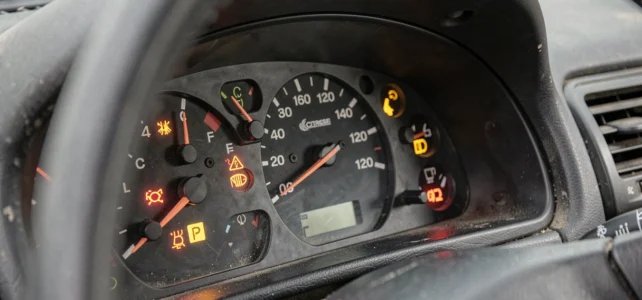
On the Xsara and Xsara Picasso, the dashboard communicates through about thirty pictograms, with the color coding logic remaining stable from one model year to the next. The technical starting point is not the shape of the symbol, but the priority level assigned by the BSI (intelligent service box): red for an immediate stop, orange for a recorded fault requiring diagnosis, green or blue for a normal state.
Mastering this hierarchy avoids unnecessary interventions as well as costly negligence.
Immobilizer light on Xsara: ghost faults and OBD diagnosis
A key or padlock pictogram that remains fixed on the dashboard after turning on the ignition is one of the most confusing faults on aging Xsaras. The engine refuses to start even though the battery, starter, and fuel supply are functional.
We observe three recurring causes behind this light:
- The non-recognition of the key transponder, related to a worn chip or a remote control that has lost synchronization with the ECU.
- Electrical or ground connections degraded by corrosion, common on the wiring harnesses of this vintage.
- A faulty immobilization module, sometimes intermittent, that records fault codes without causing the light to stay on permanently.
Visual interpretation alone is not enough: several distinct causes activate the same pictogram. Reading the specific anti-theft fault codes via an OBD port remains the only reliable method to isolate the origin. A simple generic OBD reader may not access PSA’s proprietary BSI frames. We recommend a tool compatible with the Lexia or DiagBox protocol to obtain detailed codes.
To delve deeper into the meaning of the dashboard lights on the Citroën Xsara, each pictogram is associated with its electronic source and the appropriate reaction.
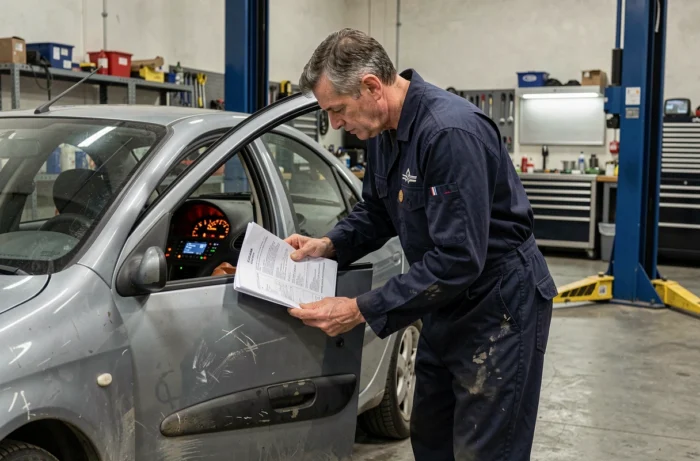
SRS airbag light and technical inspection: a reason for a re-inspection
The airbag warning light (pictogram of a passenger with a deployed airbag) that stays on while the engine is running does not always indicate a problem with the airbag. On the Xsara Picasso, the connector under the driver’s seat is the primary cause of SRS faults. The repeated movement of occupants eventually oxidizes or disconnects the presence sensor connector.
Beyond the safety aspect, this light now has a direct regulatory impact. In France, an illuminated SRS light during the technical inspection constitutes an explicit reason for a re-inspection. The vehicle cannot obtain its favorable certificate until the fault is resolved.
Correction involves electronic diagnosis to identify the fault code (connector, pretensioner, airbag ECU), followed by the erasure of the code after repair. A simple reset without repair causes the light to reappear during the next driving cycle.
Pre-checks before going to the garage
Before making an appointment, we recommend checking the condition of the yellow connector under the driver’s seat (accessible by sliding the seat back as far as possible). A cleaning with contact spray and a firm reconnection are sufficient in a significant proportion of cases.
Orange engine light and EGR valve: the most common fault on Xsara diesel
The orange engine light (stylized engine symbol) is the one that generates the most workshop visits on the HDi engines of the Xsara Picasso. The clogged EGR valve is the primary cause of this light on the diesel engines of this generation.
The mechanism is simple: the exhaust gas recirculation valve accumulates soot deposits that eventually block the throttle in either the open or closed position. The engine ECU detects an inconsistency between the commanded position and the actual position, records a fault code, and turns on the light.
The associated symptoms vary:
- Progressive loss of power, especially during low-rev acceleration.
- Unstable or slightly erratic idle when starting cold.
- Black smoke during hard acceleration, a sign of a too-rich mixture caused by the EGR flow being stuck open.
- In some cases, entering limp mode with limited engine speed.
Cleaning the EGR valve is possible by removing it, using a specific cleaner for intake circuits. If the valve body shows excessive mechanical play or a faulty stepper motor, complete replacement is necessary. After intervention, erasing the fault code via OBD is essential to turn off the light.

Oil pressure light and temperature light: two distinct emergencies
A red oil light requires an immediate engine shutdown, without exception. On the Xsara, this light (oil can) indicates that the pressure in the lubrication circuit has fallen below the critical threshold. Driving even for just one minute in this situation can cause irreversible engine seizure.
The most common causes on this model are insufficient oil level (natural consumption between oil changes), a defective pressure sensor, or, more rarely, a worn oil pump. The first action is to turn off the engine, wait a few minutes, and then check the level on the dipstick. If the level is correct and the light returns after restarting, the vehicle must be towed.
The temperature light (thermometer in a liquid) signals overheating of the cooling circuit. On the Xsara, a thermostat stuck in the closed position is the classic fault. The coolant no longer circulates to the radiator, and the temperature rises quickly. Again, a quick stop is the only response before further diagnosis.
Confusion between these two red lights is common among drivers who are not familiar with the vehicle. Their common point: neither tolerates continuing to drive “to see.” Every minute of operation exponentially worsens mechanical damage.