
We receive a gas bill expressed in kWh, but the meter displays m3. A conversion coefficient transforms a volume of gas into the actual amount of energy consumed. This coefficient is not fixed: it depends on physical parameters specific to each delivery point. Understanding this mechanism allows you to check your bill and identify any inconsistencies.
Why the gas meter displays m3 and not kWh
The gas meter measures a volume, not an energy. It records the amount of gas that passes through the pipe, expressed in cubic meters. One m3 of gas does not always contain the same amount of energy: its chemical composition, the pressure in the network, and the altitude of the municipality modify the calorific value of the delivered gas.
This is why billing cannot be based on the gross volume. Two households consuming the same volume can receive different kWh depending on their location and the characteristics of the gas supplied. The supplier therefore uses a conversion coefficient, calculated by the network manager, to convert m3 to kWh.
You can also find the complete logic to know how to convert m3 of gas to kWh starting from the basic formula: consumption in kWh = volume recorded in m3 multiplied by the conversion coefficient.
Gas conversion coefficient: what makes it vary from one municipality to another

The conversion coefficient is not a unique national value. It is specific to each municipality, sometimes even to each delivery point. Three technical parameters determine it.
- The altitude of the municipality: the higher you go, the lower the atmospheric pressure. The gas expands, and one m3 contains fewer molecules, thus less energy. The coefficient is adjusted accordingly.
- The composition of the gas: the natural gas distributed in France does not come from a single source. Depending on the origin (Norway, Algeria, LNG terminals), the higher calorific value varies. Gas richer in methane delivers more energy per m3.
- The delivery pressure: the distribution network transports gas at different pressures depending on the sections. A meter supplied at low pressure does not receive the same “usable” volume as a meter connected to a higher pressure.
In France, it is GRDF that calculates this coefficient for customers connected to the network. The value is updated regularly: once a month for smart meters, and after each reading for traditional meters read every six months.
Reading your gas bill to check the conversion from m3 to kWh
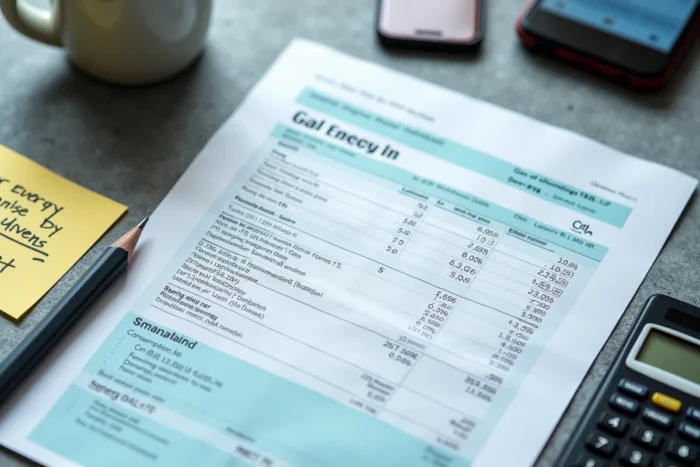
On a gas bill, you generally find three pieces of information related to the conversion: the volume recorded in m3, the conversion coefficient applied, and the consumption converted into kWh. The verification is straightforward.
You take the volume consumed between two readings (end index minus start index), and multiply it by the coefficient indicated on the bill. The result should correspond to the number of kWh charged. If the discrepancy is significant, there is a problem with the reading or the coefficient.
The conversion coefficient displayed on the bill is actually an average of the daily values calculated between the first and last day of the billing period. Therefore, we do not work with a fixed value for the year, but with data that reflects the actual conditions of the gas distributed during the relevant period.
Energy contained in gas and useful heat for the home: the distinction that matters
One point that bills do not directly show: the conversion from m3 to kWh gives the energy contained in the gas, not the heat actually delivered to the home. The difference depends on the efficiency of the heating system.
A condensing boiler recovers some of the latent heat from the flue gases and achieves a higher efficiency than a conventional boiler. The same number of kWh charged produces more useful heat with a high-efficiency device. This distinction is useful when comparing your consumption from one year to another or when evaluating the benefits of changing boilers.
Feedback varies on this point depending on the age of the installation and the maintenance performed, but the logic remains the same: the kWh charged measures the energy delivered, not the energy used.
Conversion of gas m3 to kWh: the rough rule and its limits
It is often stated that one m3 of natural gas is equivalent to about ten kWh. This approximation works as a rough order of magnitude for a quick estimate, but it does not replace the actual coefficient.
In practice, the conversion coefficient varies by municipality. A dwelling in the plains with H gas (high calorific value) will have a higher coefficient than a home at altitude supplied with B gas (low calorific value, historically distributed in northern France). Using the “times ten” rule to contest a bill does not hold: only the official coefficient calculated by GRDF is relevant.
For neighboring countries, the method differs. In Germany, billing is based on a pair “Brennwert” (calorific value) and “Zustandszahl” (correction factor related to local physical conditions), which amounts to the same principle but with a different breakdown of parameters. In Belgium, the coefficient is also communicated locally, with a value specific to the relevant distribution network.
The conversion of m3 of gas to kWh is based on a mechanism that is simple in principle (volume multiplied by coefficient), but precise in its application. The coefficient is never arbitrary: it reflects the actual physical conditions of the gas at the time of delivery. Checking this coefficient on your bill remains the most reliable action to ensure that the billed consumption corresponds to the gas actually consumed.