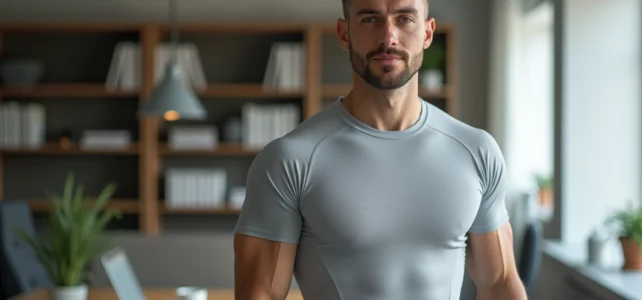
The Percko t-shirt is presented as a posture corrector integrated into everyday clothing. Sold directly by the Percko brand and listed on certain Decathlon pages, this product relies on a patented tensioning system designed to straighten the back without rigid constraints. Feedback from users varies on this point: between marketing promises, the recently highlighted status as a medical device, and criticisms from consumer associations, the assessment deserves a factual examination.
Status of the Percko t-shirt as a medical device: what it changes
The Percko t-shirt has long been perceived as a technical garment focused on well-being. The discreet model is now presented as a medical device with purely mechanical action. This classification legally frames the claims that Percko can make regarding pain relief and posture improvement.
A medical device must comply with stricter manufacturing and communication standards than a garment classified as “well-being.” This means that mentions related to the reduction of back pain are no longer merely commercial arguments, but part of a regulated framework.
This distinction is absent from the majority of user feedback published online. However, it has a direct impact on the trust that a buyer can place in the announced results. For a more detailed review of the Percko t-shirt Decathlon, recent data on this status provides useful insights.

Percko Study of March 2024: self-reported results and methodological limits
Percko has released the results of an internal quantitative study involving 391 regular users of its t-shirt. Two figures stand out: 85% of respondents report long-term relief from their pain, and 7 out of 10 report feeling muscle strengthening in their back after 21 days of wearing it.
These results prompt several remarks. The study is self-reported: participants share their feelings without objective biomechanical measurement (electromyography, motion sensors). The panel consists of regular users, which introduces a selection bias. Unsatisfied individuals who abandoned the product are not included in the sample.
What a self-reported study can and cannot prove
A feeling of relief is a real data point, but it does not allow for conclusions about a measurable mechanical action on the back musculature. The previous Osteobio/Cogitobio study, often cited by competitors, had similar limitations. The available data does not confirm a muscle strengthening effect in the physiological sense of the term.
This finding does not disqualify the product. It positions its main benefit on the side of proprioception: the tensioners remind the wearer to straighten up, which can reduce fatigue associated with prolonged poor postures.
Que Choisir’s stance on posture-correcting t-shirts: a decisive opinion
The association Que Choisir has taken a stance on posture-correcting t-shirts, deeming them unnecessary. This criticism does not only target Percko but the entire category. The main argument rests on the lack of independent clinical studies demonstrating long-term effectiveness in posture correction.
Physiotherapists consulted on the subject emphasize a technical point: a passive posture corrector does not replace active muscle strengthening. A garment with tensioners can assist in postural awareness but does not correct established hyperkyphosis or lordosis.
- The Percko t-shirt acts as a proprioceptive reminder, not as an active back rehabilitation device
- Health professionals recommend using it in conjunction with targeted exercises, never as a replacement
- Prolonged wear without associated muscle activity could, according to some practitioners, promote dependence on external support
Comfort and daily wear: what users actually report
On review platforms (Trustpilot, iGraal, Reddit forums), feedback falls into two fairly distinct categories. Satisfied users mention a wearing comfort comparable to a classic t-shirt, discretion under clothing, and a pleasant feeling of support during the first hours.
Critiques focus on three recurring points:
- The price, considered high compared to a standard technical garment (the discreet model is priced around 129 euros)
- The effect that diminishes with habituation: several users note that after a few weeks, the postural reminder becomes less noticeable
- The fit, sometimes deemed too tight or conversely insufficiently compressive depending on body types
User feedback also varies regarding durability. Some users report a loss of tension in the tensioners after several months of washing, while others do not observe any notable degradation.
French manufacturing and pricing positioning
Percko highlights a design and manufacturing in Paris. This choice of local production partly explains the product’s pricing positioning, which is significantly higher than generic posture correctors available in mass retail. The question remains whether the perceived benefit justifies this gap for daily use.
Percko t-shirt or rigid corrector: two distinct approaches
Comparing the Percko t-shirt to a rigid posture corrector (like a back brace) is akin to opposing two philosophies. The brace mechanically imposes a position on the back. The Percko t-shirt stimulates active correction by the wearer, through the tension of the integrated bands.
For individuals suffering from diagnosed chronic pain, professionals generally guide towards a management approach combining physiotherapy and, possibly, a prescribed brace. The Percko t-shirt is more aimed at a sedentary audience seeking postural support at the office or while working from home, without identified structural pathology.
The product thus occupies a specific niche. Its usefulness directly depends on the buyer’s expectations: a daily proprioceptive reminder, yes. An autonomous therapeutic solution for established pain, current data does not confirm that.