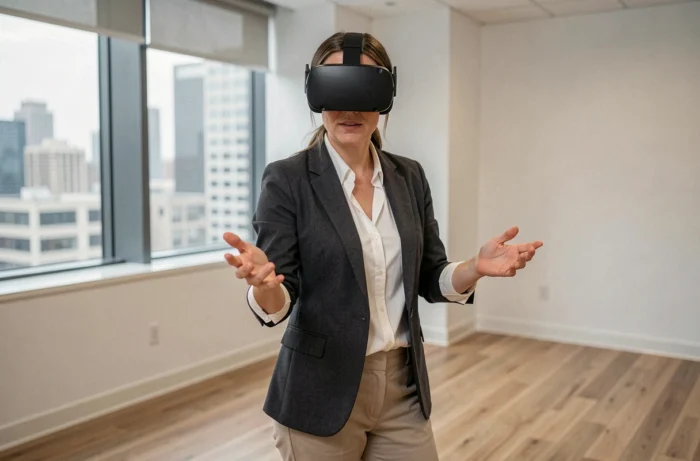
On a shipyard, training a welder to work in a confined space is expensive: equipment must be mobilized, the area blocked off, and the session supervised by two supervisors. When this same situation is replicated in virtual reality, the welder can practice the action as many times as necessary without immobilizing any workstations. It is this type of on-site constraint that is driving more and more companies to integrate VR into their professional training programs.
Transfer to the workplace: what VR still does not guarantee
Most published feedback on virtual reality training measures the learning outcomes immediately after the session. It evaluates what the learner has retained, not what they apply three months later on the job.
A systematic review published in the Journal of Computer Assisted Learning in September 2026, covering 66 studies conducted in 29 countries, confirms this observation. Longitudinal evaluations beyond the post-training phase remain very rare. The majority of studies stop at level 2 of the Kirkpatrick model, which means measuring learning outcomes rather than actual behavior on the job.
Another noted bias: the tested panels often consist of students, not active employees. Laboratory learning conditions do not replicate the pressure of a production line or an operating room. For companies investing in VR, the question of the effective transfer of skills should be addressed from the module design stage.
Players like Immersive Lab design immersive environments by integrating this logic of post-training follow-up, but feedback varies depending on the sector and the complexity of the action to be reproduced.
VR or augmented reality in training: two distinct uses not to be confused
VR and augmented reality (AR) are often mixed up when discussing immersive training. The two technologies meet different needs, and confusing them leads to inappropriate deployment choices.
When VR is the right choice
Virtual reality excels in situations that cannot be easily replicated: dangerous environments, rare scenarios, handling expensive equipment. A maintenance technician on a wind turbine trains to intervene at height without risk. An operator in a power plant learns to react to a critical alert that only occurs once a year.
VR is relevant when the real environment is inaccessible, dangerous, or too costly to mobilize. This is its structural advantage over traditional in-person training.
When AR takes over
Augmented reality overlays digital information onto the real environment. It is better suited for real-time procedural assistance: an operator wears AR glasses while performing maintenance, seeing the steps to follow displayed directly on the machine.
The systematic review mentioned earlier precisely distinguishes these two uses. AR adds value for situated learning and support for actions in real conditions, whereas VR remains confined to the acquisition phase away from the workstation.
Actual cost of a virtual reality training program
Articles on VR in training often mention “cost reduction” without detailing what the initial investment entails. Here are the items to anticipate concretely:
- The design of the immersive module (scripting, 3D modeling, integration of interactions) represents the heaviest cost, especially for custom business scenarios
- The hardware (VR headsets, computing stations, or standalone headsets) must be sized according to the number of simultaneous learners and the frequency of sessions
- Content maintenance: a VR module aligned with a regulatory procedure must be updated with each change in the standard, generating a recurring cost
Amortization depends on the volume of sessions and the number of learners trained. A company that trains 20 people a year on a single scenario will not recoup the investment in custom development. However, for geographically dispersed teams that all need to follow the same protocol, VR eliminates travel costs and the need for trainers.
Designing an effective VR module: common mistakes from the company side
Recurring patterns are observed when a company deploys VR training without sufficient pedagogical framing.
The first trap is wanting to simulate everything. An effective VR module targets a specific action, procedure, or situation. Simulating a full day of work dilutes the learning and inflates the production budget.
The second trap concerns linear scenarios. A module without decision branching is akin to watching a video with a headset on. The learner must be able to make mistakes, see their consequences, and correct their trajectory. It is this mechanism of immediate feedback that differentiates VR from a simple visual aid.
The third point is often overlooked: integration into the existing training pathway. An isolated VR module, without debriefing or connection to the skills assessed in the company, produces a “demonstration” effect that fades quickly. Companies that make the best use of VR integrate it into a blended pathway, with in-person or e-learning sequences that consolidate learning.
- Target a specific action or procedure per module, not an entire job
- Integrate decision branching so that the learner acts, not just observes
- Plan for systematic debriefing after each VR session, ideally with a trainer
- Link the module to performance indicators already monitored by the company
Virtual reality in professional training is not a miracle tool that stands alone. Its effectiveness directly depends on the quality of the scenario, the relevance of the chosen use case, and post-session follow-up. Companies that succeed in their VR deployment treat the headset as one tool among others, not as an end in itself.