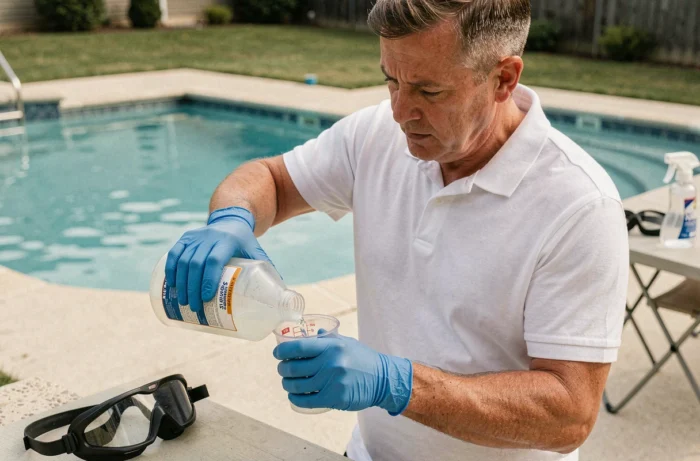
A capful of bleach is poured into the pool to correct water that is turning, and two days later the skimmer seal crumbles. This scenario appears on all pool owner forums, summarizing the problem: sodium hypochlorite disinfects the water, but simultaneously attacks the components that circulate it.
Corrosion of metal parts by bleach in a pool
The first visible damage concerns the metal elements of the filtration pump. Recent field reports indicate accelerated wear of screws, impeller shafts, and steel or brass fittings when bleach is used repeatedly. Unstabilized sodium hypochlorite causes rapid oxidation of these parts, especially when the water’s pH exceeds the neutral range.
Rust stains are also observed on low-quality stainless steel ladders and on the clamps of the hydraulic circuit. Unlike stabilized chlorine sold in tablets or granules, bleach contains no protective agents against corrosion. It delivers raw active chlorine, without any chemical buffer.
If we look at the compatibility of bleach with pool equipment, the same observation applies to the electrodes of automatic regulation systems: their lifespan decreases when the dosage of bleach is approximate, because spikes of free chlorine attack the measuring probes.
Seals, liner, and filtration: the materials that bleach degrades first
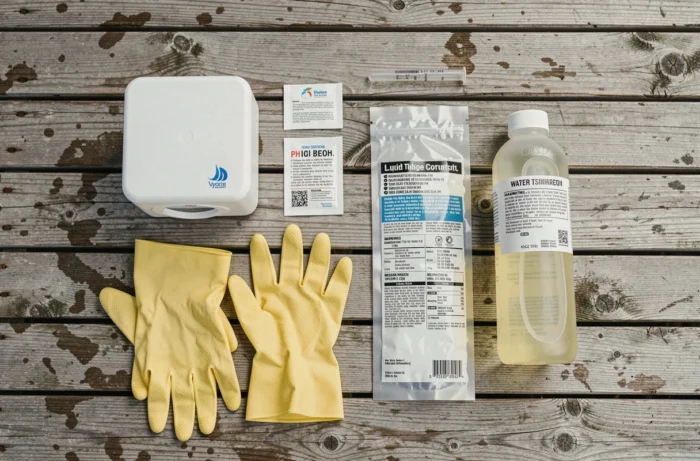
The rubber or elastomer seals of the sand filter and valve system are particularly sensitive. A regular overdose of bleach hardens and cracks these seals within a few seasons, whereas they typically last much longer with stabilized chlorine treatment.
The PVC liner also undergoes gradual discoloration. The active chlorine concentration of household bleach is around 2.6% (compared to nearly 10% for so-called “pool bleach”), but even at low concentration, a direct pour without prior dilution creates contact areas where the product whitens the wall.
Filter cartridges and filtering media
The polyester cartridges of small above-ground pool filters degrade faster under the effect of bleach than under the effect of slow-release chlorine tablets. The filtering fabric loses its rigidity, deforms, and allows fine particles to pass through. For sand or glass filtering media, the risk is lower, but clogging from the limestone residues that bleach promotes (by raising the pH) reduces filtration efficiency.
pH imbalance and chloramine formation: the double effect of bleach
Bleach is a very basic product. Each addition raises the pH of the pool water. One then finds oneself constantly correcting with a pH reducer (often based on hydrochloric or sulfuric acid), which multiplies the handling of hazardous products.
Mixing bleach with a pH corrector in the same container is strictly prohibited. ANSES reminds us that this mistake can release toxic vapors or cause a violent reaction. One never pours these two products in the same place, nor at the same time in the pool.
The other trap concerns chloramines. When the level of free chlorine is poorly controlled (which happens quickly with bleach, whose action is brief), the organic matter present in the water combines with the residual chlorine to form chloramines. These are what cause the characteristic smell of “over-chlorinated pool,” eye irritation, and skin reactions.
- The active chlorine in bleach degrades within a few hours under UV effects, necessitating frequent additions and increasing the risk of occasional overdosing.
- Without cyanuric acid (stabilizer), the level of free chlorine fluctuates greatly between two treatments, creating windows where the water is no longer disinfected.
- Repeated pH variations accelerate the deposition of scale on the walls, return jets, and the heat exchanger of the heat pump.
Concrete precautions if bleach is still used in the pool
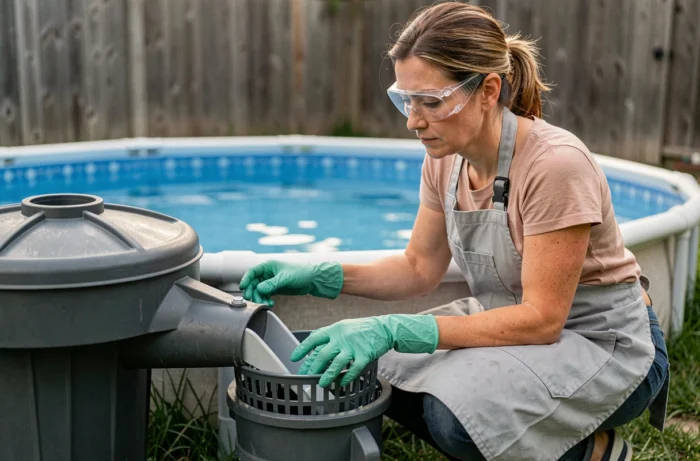
Some owners of small above-ground pools continue to use bleach, often for reasons of cost or immediate availability at supermarkets. In this case, a few rules limit damage to the equipment and water quality.
- Dilute the bleach in a bucket of water before pouring it into the pool, never in a direct jet onto the liner or near the skimmer.
- Measure the pH after each addition with strips or an electronic tester, and correct immediately if the pH exceeds 7.4.
- Never store bleach next to a pH corrector or algaecide: the cross vapors are enough to cause a chemical reaction.
- Rinse the filter with clear water more often than with a standard treatment, to prevent limestone residues from clogging the filtering media.
Stabilized chlorine or salt electrolysis: alternatives that preserve equipment
Stabilized chlorine treatment (dichloroisocyanurate tablets) releases chlorine gradually and includes a stabilizer that protects the molecule from UV. Filtration equipment and seals last significantly longer than with bleach treatment, because the pH remains more stable and concentration spikes are avoided.
Salt electrolysis produces sodium hypochlorite directly in the water, at low concentration and continuously. The chemical principle is the same as bleach, but automatic regulation prevents overdosing. Feedback varies on this point depending on the quality of the electrolysis cell, but most installers consider it the least aggressive system for pool equipment.
Using bleach remains an acceptable occasional fix for a shock treatment of green water, provided that dilution is respected and pH is monitored in the hours that follow. Making it a regular treatment accelerates the wear of every component of the hydraulic circuit, from the valve seal to the liner, without guaranteeing consistent disinfection between two additions.