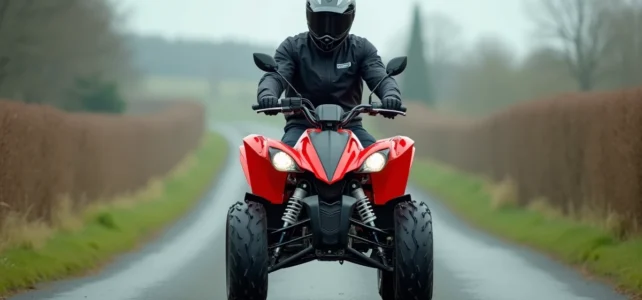
The 125 cm³ quad occupies a special place in the landscape of motorized quadricycles. Neither a recreational toy nor a fully-fledged road vehicle, it sits on the border between two uses that French regulations distinguish with precision. Understanding what road homologation means for a 125 quad first requires accepting that behind the same engine size lie very different administrative categories, equipment obligations, and usage limits.
Categories L6e and L7e: what the term “125 homologated” conceals
Talking about a “125 homologated quad” without specifying the homologation category is akin to comparing two vehicles that do not follow the same rules. European regulations distinguish two categories of motorized quadricycles: the light quadricycle L6e and the heavy quadricycle L7e.
A quad classified as L6e is limited in speed and power. It is aimed at a young audience or drivers holding an AM license. A quad classified as L7e, even with a 125 cm³ engine, can go faster and requires a B or A1 license depending on the case. The requirements for braking, lighting, and structure differ from one category to another.
This distinction has direct consequences for safety. An L7e generally has more robust suspensions, a hydraulic braking system on all four wheels, and a chassis designed to withstand the stresses of road traffic. Therefore, choosing the 125 homologated quad for the road means checking its homologation category before any other technical consideration.
Safety of the 125 quad on the road: obligations and blind spots
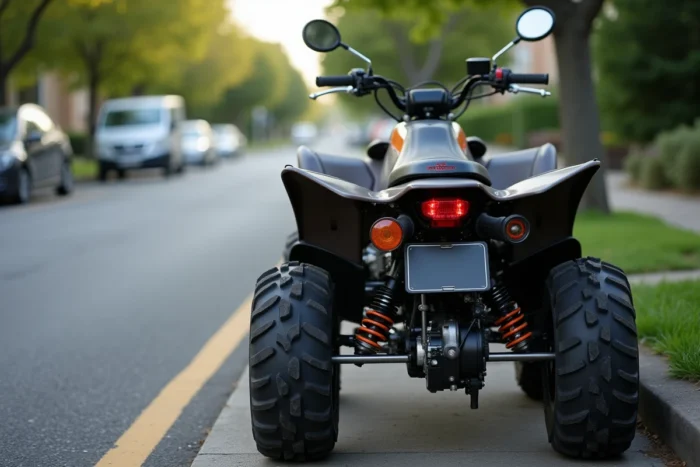
Road homologation imposes a baseline of signaling equipment: turn signals, position lights, low and high beam lights, hazard lights, mirrors, and license plate lighting. These elements are checked during registration and, since 2024, during the technical inspection.
The technical inspection, a new factor for road quads
The technical inspection now applies to road homologated quads of categories L6e and L7e. The schedule is staggered according to the age of the vehicle. This obligation changes the game for owners: a road quad must be maintained in a verifiable mechanical condition, which was not previously checked.
In practice, this means that brakes, suspensions, lighting, and steering are subject to periodic examination. For a 125 quad, whose wear parts are often stressed by mixed use (road and trails), maintenance costs increase.
The structural limits of a quadricycle
A quad, even when homologated, remains a vehicle without a closed cabin, without seatbelts, and without airbags. The passive protection of the driver relies entirely on individual equipment: homologated helmet, gloves, reinforced jacket. The wearing of a helmet is mandatory, but no regulation requires specific back or joint protection.
Field reports vary on the road behavior of a 125 quad in urban traffic. Its width, seat height, and lack of bodywork make it more vulnerable than a scooter in dense traffic flows. On the other hand, its four wheels provide superior stability at low speeds and on degraded road surfaces.
Actual performance of the homologated 125 quad: what to expect
The performance of a homologated 125 quad is not measured by its top speed. A road homologated quad is still prohibited on highways and fast lanes, even when it is perfectly compliant. Its relevant terrain is secondary roads, suburban routes, and communal paths.
On these routes, a 125 cm³ delivers sufficient power to maintain a smooth pace. The torque available at low revs facilitates acceleration out of corners or uphill. The available data do not allow for precise performance comparisons between brands, as configurations (automatic or manual transmission, two or four-wheel drive) vary from model to model.
- Automatic transmission (CVT) simplifies road driving but reduces engine control on descents or soft terrain.
- Manual transmission offers better power modulation, at the cost of a more demanding learning curve for beginners.
- Four-wheel drive models provide superior traction on wet ground but add weight and mechanical complexity.
The weight of the quad directly influences comfort and maneuverability. A lightweight model will be more agile in the city but less stable at high speeds on open roads. The choice is made based on the dominant use.
Insurance and legal framework: the real cost of road homologation
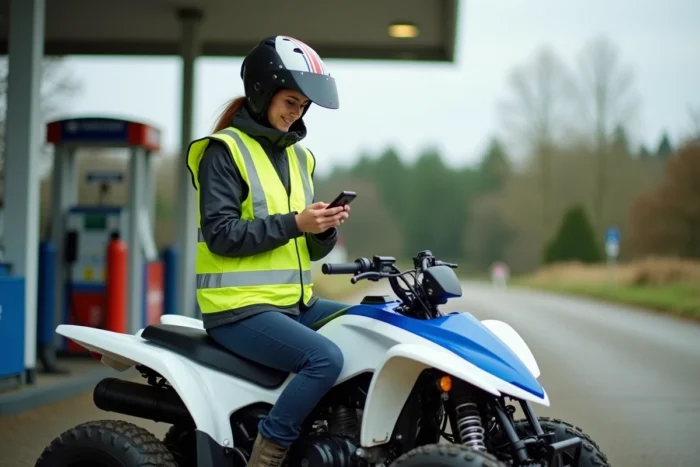
Civil liability insurance is mandatory as soon as a quad circulates on public roads, even for occasional use or low power. This point is often underestimated by buyers who only compare the purchase price between a homologated quad and a non-homologated model.
Road homologation also requires registration, thus a registration certificate. In the event of an accident without insurance or registration, the financial and legal consequences are identical to those of a motor vehicle driver in violation.
- A non-homologated quad circulating on the road exposes its driver to a fine and vehicle confiscation.
- The absence of insurance results in the driver being responsible for bodily and material damages, with no cap.
- The technical inspection, now applicable, adds a periodic expense item to anticipate.
The overall budget for a homologated 125 quad thus exceeds just the purchase price. Insurance, maintenance, technical inspection, and individual equipment form a set that non-homologated models do not impose, but which they also do not cover in the event of a claim.
The 125 homologated quad for the road is neither a scooter nor a motorcycle. Its relevance depends on a specific use: short trips on secondary roads, rural or suburban areas, where its stability and versatility compensate for its speed and protection limits. Checking the homologation category, budgeting for all regulatory costs, and choosing appropriate protective equipment remain the three considerations that separate a thoughtful purchase from an unpleasant administrative surprise.