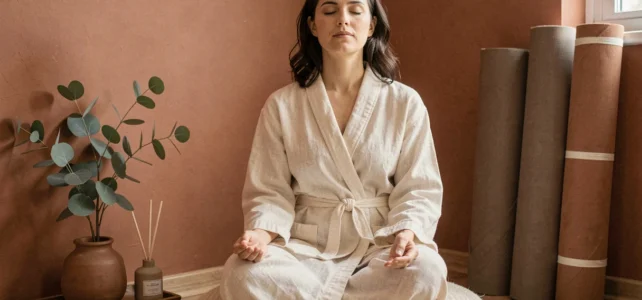
Creating a wellness space at home is not just about placing a meditation cushion in a corner of the room. The choice of materials, indoor air quality, and lighting directly influence a place’s ability to promote relaxation. Comparing these parameters helps identify the levers that produce a measurable effect on the comfort felt, far from generic decorative lists.
Low VOC Materials vs. Standard Materials: Impact on the Air Quality of a Relaxation Space
Volatile organic compounds (VOCs) emitted by paints, varnishes, and particle boards continuously pollute indoor air. In a closed room dedicated to relaxation, this chemical load directly contradicts the goal of rejuvenation.
Since 2024, recommendations for interior design emphasize low VOC paints, FSC-certified woods, and natural oils and waxes. The issue is not just aesthetic: it is about reducing invisible pollution in the space where we breathe most deeply.
| Criterion | Standard Materials | Low VOC Materials |
|---|---|---|
| VOCs Emissions | High in the first months, persistent | Very low from installation |
| Residual Odor | Often perceptible for several weeks | Almost none after drying |
| Maintenance | Conventional products (often chemical) | Black soap, vinegar, natural waxes |
| Touch Sensation | Variable (laminate, melamine) | Raw textures (solid wood, linen, stone) |
| Indicative Cost | More accessible | Slightly higher at purchase |
The additional cost of purchasing low VOC materials remains moderate. However, the gain in respiratory comfort in a wellness corner used daily is significant, especially in small spaces where air is renewed less quickly.
Exploring complementary approaches to singing bowl relaxation with C Ma Déco enriches this sensory approach by adding a sound dimension to the designed space.
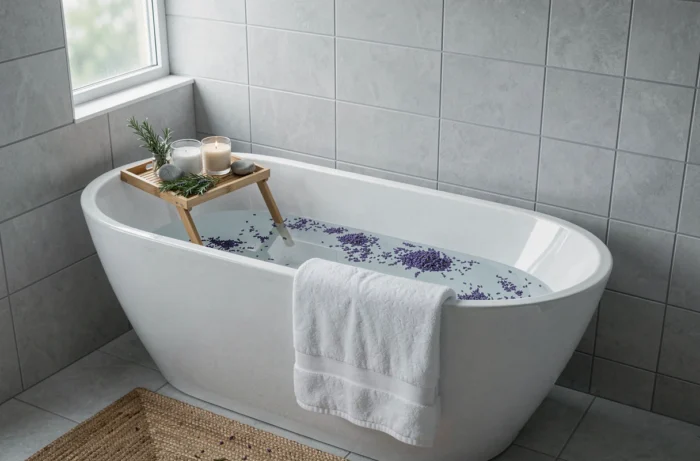
Circadian Lighting and Natural Light: Two Logics for a Relaxation Corner
Light modifies physiological states far more than wall color. A wellness space illuminated by a cold white ceiling light produces the opposite of the desired effect, even if the furniture is perfectly chosen.
Two options stand out for a relaxation-oriented interior design.
Direct Natural Light
A corner set up near a south or west-facing window benefits from warm light at the end of the day. This configuration costs nothing and naturally adapts to the biological rhythm. The trap: glare in summer, which can be mitigated by linen curtains without blocking brightness.
Connected Lighting Adjusted to the Circadian Rhythm
The trends for 2025 describe a discreet integration of home automation in relaxation areas. Programmable bulbs replicate the day’s light curve: bluish light in the morning, amber in the evening. The interface remains invisible, hidden behind an app or a conventional switch.
The principle is simple: technology should not dominate the room. An exposed LED strip under a shelf disrupts the atmosphere as much as a neon light. Recessed or indirect solutions (backlighting behind furniture, table lamp with dimmer) preserve the cocoon-like ambiance.
Warm Minimalism Applied to the Wellness Space: Fewer Objects, More Sensations
Interior trend analyses for 2025-2026 converge on one observation: decorative overload generates visual fatigue that sabotages relaxation. The warm minimalism movement offers a compromise between simplicity and sensory comfort.
In practical terms, this means reducing the number of objects in the room while choosing materials that engage touch and sight in a soothing manner.
- Earth tone palette (sand beige, terracotta, muted greens, cocoa brown) instead of clinical white or bright shades
- Textiles with pronounced textures: boucle wool for a throw, raw linen for cushions, waffle cotton for a rug
- Natural unvarnished wood, raw stone, or waxed concrete for surfaces, adding depth without extra accessories
- Green plants limited to two or three robust specimens instead of a jungle that requires constant maintenance
The guiding idea can be summed up in one sentence: every object present in the space must have a specific sensory function. A cushion for sitting on the floor, a candle for scent, a throw for warmth. The rest is clutter.
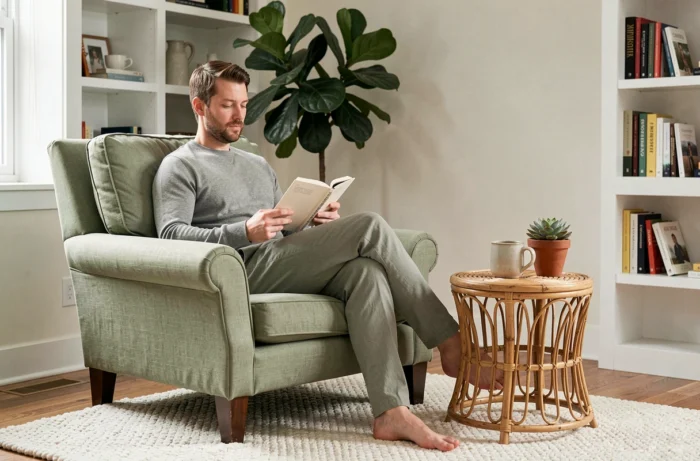
Soundproofing the Relaxation Corner: The Underestimated Parameter
A wellness space located against a shared wall with the kitchen or hallway loses a significant part of its effectiveness. Noise is the primary factor that prevents relaxation, ahead of light or temperature.
Some simple interventions can change the situation without heavy work:
- A thick velvet or wool curtain placed in front of a door or opening absorbs mid-range frequencies (voices, television)
- A dense rug on the floor reduces reverberation and impact noise (footsteps, chairs)
- A filled bookshelf against a shared wall acts as a natural acoustic screen
Textiles absorb sound, hard surfaces reflect it. In a relaxation corner, the ratio of soft surfaces to hard surfaces determines the perceived level of calm. Prioritizing fabric over glass and wood over tile radically changes the sound atmosphere.
This parameter weighs as much as the choice of furniture. A comfortable armchair in a resonant room remains just an armchair where one cannot settle down.
Designing a relaxation space relies less on accumulating equipment and more on mastering three variables: air quality, light, and sound level. These physical parameters, rarely addressed together, transform a simple nook into a place where the body can truly slow down.