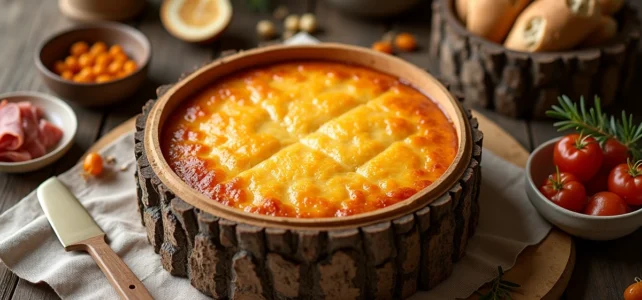
The baked Mont d’Or is among the most shared winter recipes online. Almost all published versions rely on the same reflex: pouring white wine over the cheese before baking. Removing this ingredient alters the behavior of the cheese during cooking, the aromatic profile of the dish, and its accessibility for some guests. Measuring these differences allows for informed choices regarding alternatives.
Baked Mont d’Or with and without white wine: what changes during cooking
The white wine serves two technical functions in the classic recipe. It provides an acidic liquid that helps the crust crack and deposits fruity aromas that concentrate under the effect of heat. Removing this liquid does not make the cheese dry: the Mont d’Or, which is very rich in water, melts significantly on its own.
However, the absence of wine slightly shortens the optimal cooking window. Without additional moisture, the crust may brown more quickly. Therefore, it is necessary to monitor the coloration more closely or cover the box with aluminum foil during the first few minutes.
| Criterion | With white wine | Without wine (natural or substitute) |
|---|---|---|
| Melted cheese texture | Very fluid, almost liquid in the center | Creamy, slightly denser |
| Dominant aromas | Fruity, varietal notes | Woody (spruce), lactic, pure terroir |
| Risk of overly dry crust | Low | Moderate if no lid or liquid substitute |
| Alcohol-free compatibility | No | Yes |
| Suitable for children / pregnant women | Debated (possible residual alcohol) | Yes |
This table shows that the main difference lies in the aroma, not in the texture. A well-aged Mont d’Or, baked in its spruce box, already develops a complex woody aroma. The wine adds a layer but does not create the creaminess of the cheese.
To delve deeper into this approach, a recipe for baked Mont d’Or without wine details the steps adapted to each liquid substitute.
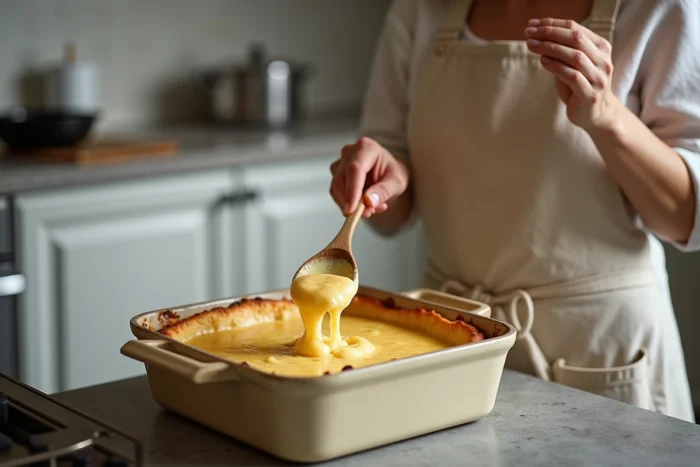
Liquid substitutes to flavor Mont d’Or without alcohol
Removing the wine does not mean baking the cheese dry. Several liquids fulfill the hydrating and aromatic function of white wine, with very different profiles.
- Vegetable broth: a few spoonfuls poured over the top of the cheese provide a salty and umami base. The most neutral option, it allows the flavor of the Mont d’Or to dominate.
- Unfiltered apple juice: its fruity sweetness recalls the traditional Comtois pairings of apple and cheese. The slight acidity helps the crust crack, just like the wine would.
- Non-alcoholic beer: blonde or white versions add a mild bitterness and malt notes. This substitute is the closest to white wine in terms of aromatic complexity.
- Liquid cream: it enriches the texture rather than the aroma. The result is an even creamier melted cheese, ideal for dipping country bread.
The choice of substitute depends on the meal. For a dinner where Mont d’Or accompanies potatoes, broth or apple juice offers a balance between flavor and lightness. For an appetizer where the cheese is the centerpiece, non-alcoholic beer adds complexity without overshadowing the spruce.
Mont d’Or without wine as an inclusive dish: beyond the taste issue
The demand for alcohol-free recipes has significantly increased in recent years in culinary media and public workshops. The reasons go beyond simple taste preference.
Public health recommendations encourage reducing alcohol in family recipes, especially for meals shared with children or pregnant women. Even though some alcohol evaporates during cooking, the residual fraction remains difficult to quantify precisely in a dish like Mont d’Or, where the cheese does not reach a uniform temperature.
The issue of rennet and religious requirements
Removing the wine does not automatically make Mont d’Or compatible with all religious dietary requirements. French AOP cheeses use animal rennet regulated by the specifications of the designation. This regulatory constraint prevents halal certification under the current framework of AOP Mont d’Or.
Offering a version without wine expands the circle of guests (children, non-drinkers, drivers), but it remains useful to know this limit to avoid presenting the dish as universally compatible. A Mont d’Or without wine is an alcohol-free dish, not a halal or kosher certified dish.
Cooking and accompaniments: adjusting the details for a melting result
Without wine, preparing the baked Mont d’Or relies on a few simple adjustments that change the final result.
Preparing the box
Remove the spruce lid. Score the cheese crust in a cross pattern with a knife, then insert a few cloves of garlic and a sprig of rosemary into the incisions. These herbs compensate for the absence of wine by bringing bright notes. Wrap the bottom of the box in aluminum foil to prevent it from burning.
Temperature and duration
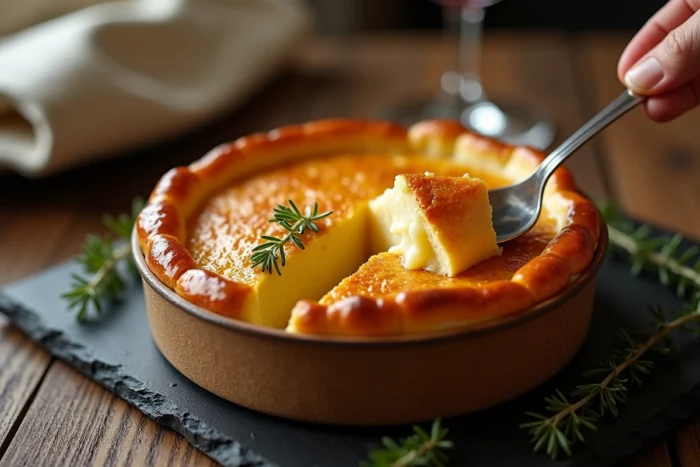
Bake at moderate heat. The cheese is ready when the surface quivers slightly and the cheese flows when spooned. Covering the box with its lid or a sheet of aluminum during the first half of the cooking helps retain moisture and achieve an even melt.
Accompaniments that complement the dish
- Steamed or jacket potatoes: the classic accompaniment, which absorbs the melted cheese without competing with it
- Grilled country bread or slices of nut bread: the crunchy textures contrast with the creaminess of Mont d’Or
- Smoked charcuterie (raw ham, bacon): the smoky notes extend the woody aroma of the spruce
- Endive salad with walnuts: the bitterness and crunch balance the richness of the cheese
The baked Mont d’Or without wine highlights the cheese itself. A well-aged product, purchased in peak season, offers a sufficiently aromatic paste to carry the dish with just a sprig of rosemary and a clove of garlic. The best substitute for wine remains a Mont d’Or chosen at its peak maturity.