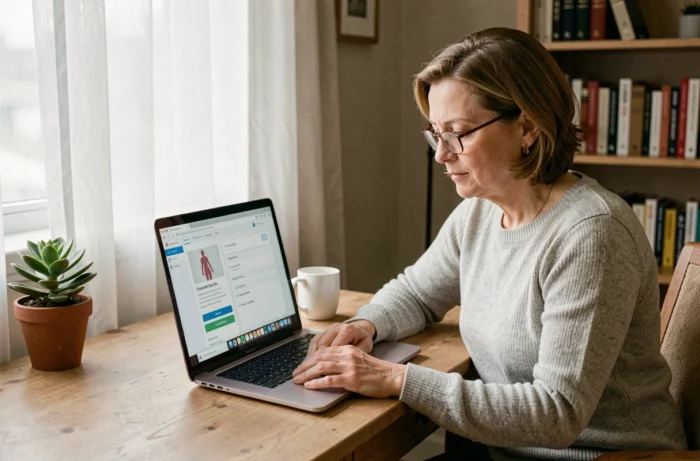
Most medical analysis laboratories in France now offer online access to biological results. Patients generally receive an identifier and a password at the time of the sample collection, followed by a link via email or SMS once the report is validated. Alongside these laboratory portals, Mon espace santé (successor to the DMP) also centralizes some health documents. Two channels coexist, with scopes that do not completely overlap.
Biological validation and delay in online publication of results
A point rarely detailed by the platforms themselves concerns the gap between the technical production of a result and its actual publication. A well-designed portal distinguishes the technically produced result from the result validated by the medical biologist. As long as this validation has not taken place, the report does not appear in the patient space.
This delay can range from a few hours to more than a day depending on the nature of the analysis. Common tests (complete blood count, blood sugar, lipid profile) are generally available on the same day or the next day. Specialized analyses (serologies, bacterial cultures, hormonal markers) require a longer technical delay, in addition to the time for the biologist’s review.
For the patient, this means that a result absent from their online space is not necessarily delayed: medical validation is a mandatory security lock before any dissemination. Some laboratories send a notification via SMS or email only after this step, which prevents empty consultations of the portal.
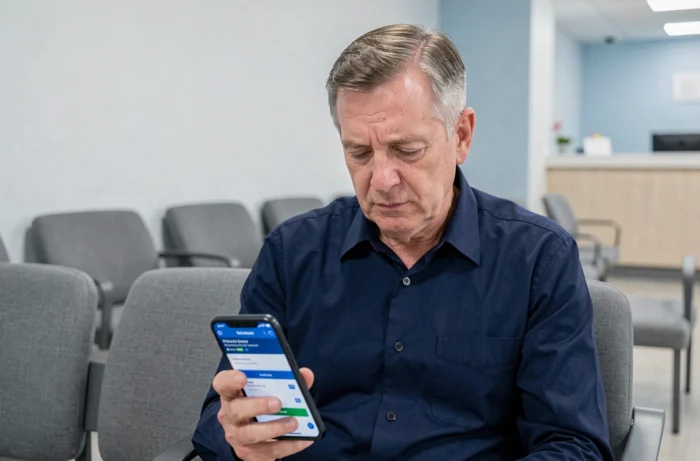
If you go through a laboratory in the Biofutur network, you can check your results on Cydlab as soon as the biologist has finalized the report.
Laboratory portal or Mon espace santé: two accesses, two logics
The laboratory-specific portal (mesanalyses.fr, mySYNLAB, Mon Espace Biogroup, Cerballiance patient space, etc.) remains the main channel for downloading a report in PDF, consulting the history of samples, or settling any remaining charges. Mon espace santé complements these portals rather than replacing them.
The difference is structural. The laboratory portal offers local services: appointment scheduling, messaging with the biologist, detailed access to previous analyses. Mon espace santé, on the other hand, aggregates documents from several healthcare professionals into a shared medical record (DMP). A biological report can be automatically deposited there by the laboratory.
- The laboratory portal provides access to the complete PDF, often with previous results and graphs showing the evolution of markers.
- Mon espace santé centralizes documents from different professionals (general practitioner, hospital, laboratory) in a single space.
- Results deposited in Mon espace santé become visible even if the patient has never activated their account beforehand, according to information published on September 15, 2026.
- A general practitioner can consult the results via Mon espace santé without the patient needing to manually transmit them.
In practice, checking both spaces makes sense when changing laboratories or when wanting to retrieve an old examination prescribed by another professional.
Health data security and access rights
Access to biological results online raises a question that goes beyond mere convenience. Health data is among the most sensitive categories under the GDPR, and incidents do occur.
A professional can only consult the data necessary for their mission. Simply having a technical identifier does not constitute a general authorization to access the file. This principle of “need to know” governs both hospital access and that of city laboratories.
On the patient side, several precautions limit risks:
- Never transmit your access codes to the portal via unsecured messaging or by phone.
- Prefer two-factor authentication (SMS code + password) when the laboratory offers it.
- Regularly check access logs in Mon espace santé, which allows you to see which professional consulted the file and on what date.
Mon espace santé also offers the option to hide certain documents or restrict access to specific professionals. The patient retains control over the visibility of their results in the DMP, even after automatic deposit by the laboratory.
Concrete limits of online consultation
Digital access to results does not cover all scenarios. Laboratories use HPRIM links to transmit data to patient portals, but not all laboratory software manages all formats. Some atypical results (complex antibiograms, smear images) may only partially appear online.
Field feedback also varies regarding the reliability of notifications. An SMS or email notification depends on the correct entry of contact details at the laboratory’s secretariat. An error in a number or an outdated email address is enough to block the information without the patient being aware.
Another limitation: the coexistence of multiple portals can create confusion. A patient followed in two laboratories from different networks will have to juggle between two interfaces, two sets of identifiers, and two navigation logics. Mon espace santé mitigates this problem by centralizing documents, but its adoption by all biology structures remains gradual.
Online consultation also does not replace medical interpretation. An abnormal result displayed on a screen without commentary from the biologist or prescribing physician can generate disproportionate anxiety. Several laboratories add contextual notes on their portals, but reading remains clearer during a direct exchange with the healthcare professional.