The layout of a house is not limited to choosing a sofa or a wall color. Every technical decision, from surface treatment to circulation sizing, affects daily comfort for years to come. Here, we address the points that general public guides overlook, with a focus on construction and real usage.
Hierarchy of floor coverings: balancing usage and maintenance
The choice of a floor covering determines the frequency and cost of maintenance throughout the lifespan of the room. We recommend thinking in terms of usage zones rather than aesthetics alone.
In kitchens and entrances, a full-body porcelain stoneware withstands shocks, acid spills, and heavy foot traffic without surface treatment. A classic glazed tile, on the other hand, sees its glaze deteriorate within a few years in these areas, leading to dirty joints and a dull appearance that is hard to recover.
For living rooms and bedrooms, engineered wood flooring with a wear layer greater than 3.5 mm allows for renovation sanding after ten to fifteen years. Below this thickness, sanding is impossible, and the covering becomes disposable. Laminate flooring, despite its attractive price, can never be renovated: it must be replaced.
Those looking for practical information on Recommandons will find useful benchmarks to compare the technical performance of each type of flooring before making a decision.
In humid rooms (bathrooms, laundry rooms), click-lock LVT vinyl with a minimum R10 slip-resistant treatment remains the best compromise between ease of installation, water resistance, and ease of cleaning. Tile remains relevant there, provided one invests in epoxy joints, which are significantly more resistant to mold than cement joints.

Color and interior light: common technical mistakes
The color of a wall should not be chosen from a color chart in a store. The temperature of the lighting radically alters the perception of a hue: a warm gray leaning towards beige under 2,700 K lighting can turn into a dirty purple under a 4,000 K bulb.
We regularly observe disappointments related to this discrepancy. The solution: systematically test a sample painted directly on the wall in question and observe it at three different times of the day, under natural light in the morning, late afternoon, and under artificial light in the evening.
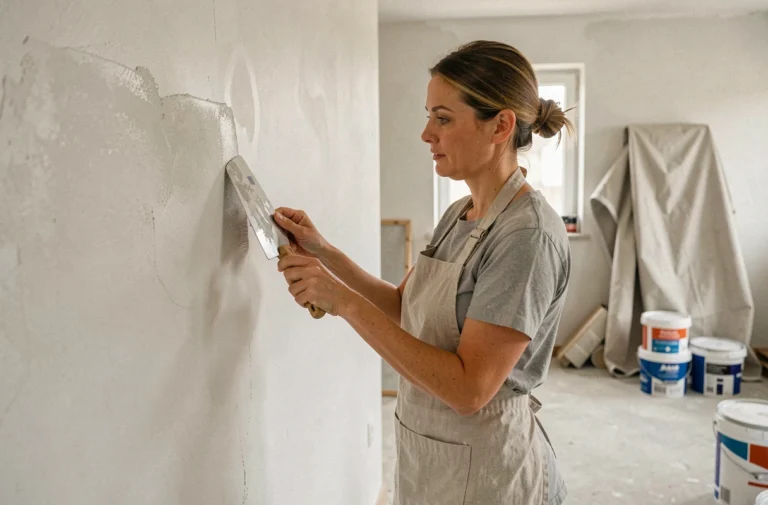
The finish is as important as the hue. A matte paint absorbs light and hides surface defects, but shows marks with the slightest friction. A satin finish, more washable, is suitable for hallways and living spaces. The velvet finish offers the best compromise between color depth and durability, provided one works on a perfectly prepared surface (smooth coating, minimum 120-grit sanding).
Common pitfalls with dark colors
Dark shades (midnight blue, forest green, deep terracotta) require two additional coats compared to white for a uniform result. The cost in paint and labor time nearly doubles. This is a factor rarely included in initial estimates.
A dark wall in a room smaller than 12 m² without direct natural light creates a cave effect rather than a cocoon effect. It is better to reserve the strong hue for a single wall and treat the other walls with a complementary light color.
Routine maintenance: delegating with a 50% tax credit
The personal services market in France represents 22.8 billion euros in revenue in 2024, with 884 million hours worked throughout the year. This growth reflects a significant shift: cleaning, gardening, and small jobs are increasingly outsourced, even by working families.
The main lever remains fiscal. Using an approved organization for routine home maintenance (cleaning, ironing, gardening, minor repairs) entitles you to a 50% tax credit on expenses, generally capped at 12,000 euros per year. In practical terms, an hour of cleaning billed at 25 euros costs 12.50 euros after the tax credit.
This mechanism makes delegation competitive compared to the time spent doing it oneself, especially when factoring in the cost of products and equipment. Here are a few criteria for choosing a reliable service provider:
- Check the SAP (Personal Services) approval of the organization, a necessary condition to benefit from the tax advantage
- Prefer a contract with a single point of contact and a regular worker, ensuring consistency in cleaning quality
- Request an annual tax certificate detailing the amounts, necessary for income declaration

Kitchen layout: circulation and ergonomics before style
The kitchen remains the room where layout errors are most costly in daily life. An improperly sized activity triangle generates thousands of unnecessary steps each week. The three poles (storage, washing, cooking) should be spaced 1.20 m to 2.70 m apart for suitable working comfort.
Below 1.20 m, the stations overlap, and two people cannot work simultaneously. Beyond 2.70 m, fatigue from movement accumulates, especially for everyday meals prepared while standing.
Worktop: height and material
The standard height of 85 cm is suitable for people between 1.60 m and 1.70 m tall. Beyond that, we recommend raising it to 90 cm or even 95 cm to avoid chronic back pain. This is a modest additional cost at the time of order, but a very expensive modification after installation.
In terms of material, reconstituted quartz surpasses granite on one specific point: its nearly zero porosity eliminates the risk of permanent stains without annual waterproof treatment. Solid wood, visually appealing, requires quarterly oiling and remains vulnerable to heat rings.
Every layout decision, from the floor to the worktop, should be treated as a technical arbitration rather than a decorative choice. Trends come and go, but design flaws remain.