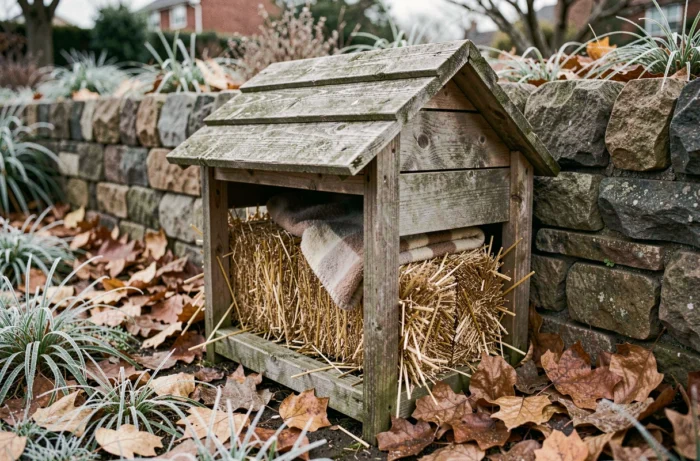
A stray cat loses its body heat mainly through conduction with the ground and convection due to the wind. Insulating a shelter for a stray cat involves blocking these two mechanisms with suitable materials while managing a third often overlooked factor: the moisture produced by the animal itself. A poorly ventilated shelter accumulates water vapor from the cat’s breath, which moistens the bedding and negates the insulating effect.
Water vapor and condensation in a cat shelter: the invisible trap
Most insulation guides for stray cat shelters focus on wind and frost. Managing indoor humidity is at least as crucial for the animal’s survival in extreme cold.
An adult cat at rest emits water vapor through breathing. In a compact and closed shelter, this vapor condenses on the cold walls and then falls back onto the bedding. Wet bedding conducts heat much faster than dry bedding: the cat then cools from underneath, exactly what the shelter was supposed to prevent.
The solution relies on two principles. The first: plan for micro-ventilation by drilling one or two small holes (finger-sized) near the top of the shelter, on the side opposite the entrance. These openings allow vapor to escape without creating a draft at the level of the cat.
The second: choose bedding that does not absorb water. As detailed on the Cani Essence website, straw remains the reference material because it repels moisture instead of retaining it, unlike fabric blankets or hay.
Straw, polystyrene, fabric: which insulation to choose for an outdoor shelter
The choice of insulation materials directly determines the indoor temperature of the shelter. Not all insulators are equal when facing damp cold.
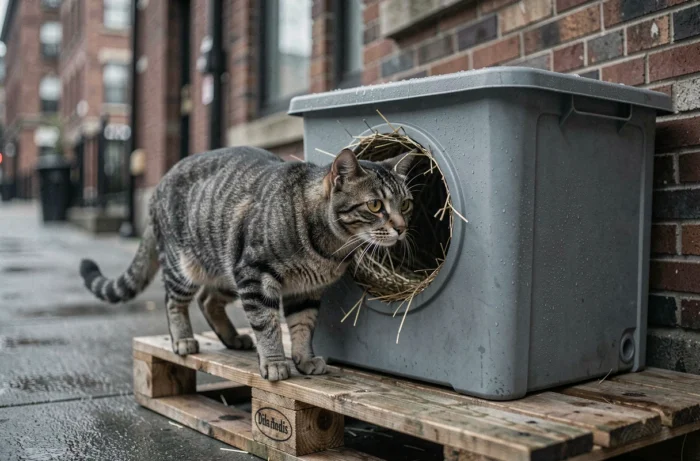
Wheat straw is the best passive insulator for a stray cat shelter. Its hollow stems trap air, it does not retain water, and it compresses little. Hay, visually similar, absorbs moisture and molds within a few days: it should be systematically excluded.
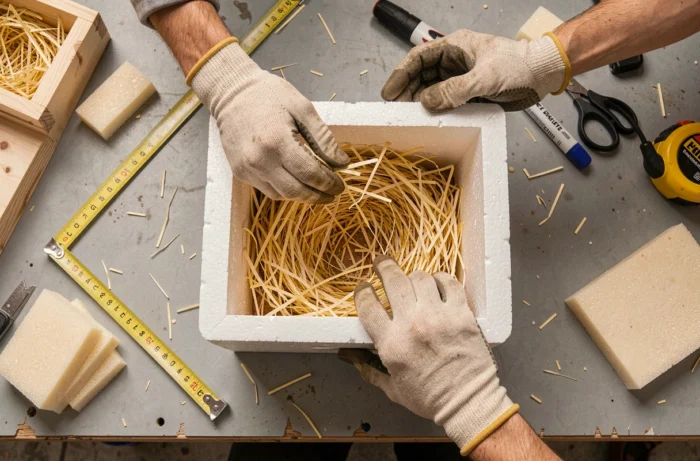
For the structure of the shelter, expanded polystyrene (like fish boxes) offers an excellent insulation-to-cost ratio. A polystyrene cooler obtained for free from a fishmonger makes for an effective shelter in less than ten minutes. Thick plastic bins (like storage bins) also work, provided a layer of polystyrene is glued inside on the bottom and walls.
Here are the materials to prioritize and those to avoid:
- Thick layer of wheat straw at the bottom and on the inner sides, replaced every two to three weeks to maintain its insulating properties
- Expanded polystyrene for the walls and floor, protected by wide adhesive tape if the cat scratches
- Plastic film or thick garbage bag as an outer layer to block wind and rain infiltration
- Blankets, towels, carpets: to be avoided, as they absorb moisture and freeze, worsening the cold instead of reducing it
Dimensions and location: two common mistakes regarding shelters for stray cats
A shelter that is too large does not protect from the cold. The thermal principle is simple: the cat warms the indoor air with its body heat alone. The larger the air volume, the slower the temperature rises and the faster it drops as soon as the animal exits.
The ideal interior space allows the cat to turn around comfortably, no more. A box about 40 by 50 centimeters on the floor, with an interior height of about thirty centimeters, is sufficient for an adult cat. The entrance should be reduced to the strictly necessary size for the animal to pass through and oriented away from prevailing winds.
The location is as important as the construction. Place the shelter under a porch, awning, or against a wall exposed to the south. Elevating it a few centimeters off the ground (with a pallet, bricks, or wooden legs) prevents cold and moisture from rising through the floor. A shelter placed directly on a concrete floor or on the ground loses a significant part of its insulation through conduction.
Heated shelter for outdoor cats: mandatory electrical safety
Heating pads and shelters for cats are spreading rapidly, including for colonies of free-roaming cats managed by associations. This option provides real comfort during prolonged frosts, but it requires non-negotiable precautions.
- Only use heating pads or panels with a recognized safety certification (like MET or UL), designed for outdoor animal use
- Plug the device into an outdoor outlet protected by a GFCI circuit breaker, which cuts off the power in case of electrical leakage
- Place the power cord out of reach of standing water and melting snow, ideally under an awning or in a protective sheath
- Regularly check the condition of the cable, as rodents can damage the insulating sheath in just a few nights
A well-insulated passive shelter (polystyrene, straw, good ventilation) already maintains an indoor temperature significantly higher than the outside temperature thanks to the cat’s body heat alone. The addition of electric heating is only relevant when temperatures drop persistently below zero.
Food and water in freezing weather: complementing the insulation of the shelter
A stray cat in winter burns more calories to maintain its body temperature. Placing food and water near the shelter, but not inside (to avoid attracting other animals into the sleeping space), remains the most effective practice.
Water freezes quickly in negative temperatures. A practical tip is to use a dark and deep container instead of a flat bowl: the larger volume of water takes longer to freeze, and the dark color absorbs solar heat during the day. Renewing the water twice a day remains the most reliable method when not using a heated bowl.
An insulated shelter with straw, properly sized, elevated, and placed out of the wind effectively protects a stray cat throughout the winter. Regular maintenance (replacing the straw, checking for leaks, cleaning the bowl) makes the difference between a functional refuge and a damp box that the cat will eventually abandon.