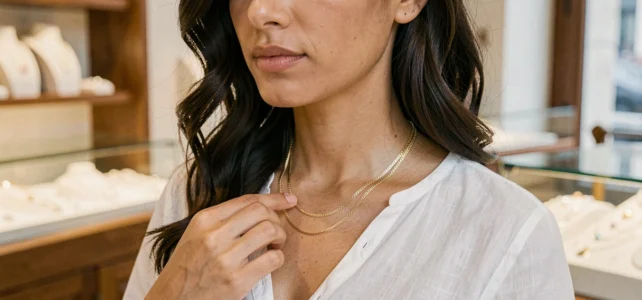
A piece of jewelry acts as an immediate visual signal: even before a word is spoken, it shapes the perception others have of your appearance. The choice of a ring, necklace, or earrings reflects specific aesthetic preferences, as well as a relationship to the body, proportions, and materials. Understanding these mechanisms allows for more coherent choices that align with your morphology and daily style.
Face Proportions and Earring Choices
The link between face shape and the type of earrings that suit it is based on a simple principle: the jewelry should compensate for the dominant proportions of the face, not accentuate them. A round face gains structure with elongated or dangling earrings that visually stretch the oval. Conversely, an angular face (defined jawline, prominent cheekbones) is softened by rounded shapes or hoops.
For an oval face, most styles work, but that doesn’t mean anything goes. Earrings that are too small disappear on a wide face, and overly long dangles can overwhelm a slender face. The size of the earlobe also matters: a bold piece on a small lobe creates an imbalance that draws attention for the wrong reasons.
Several catalogs now allow you to filter models by face shape or style, like on magie-des-bijoux.fr, making selection easier for beginners.
Metals and Skin Tones: Harmonies to Know
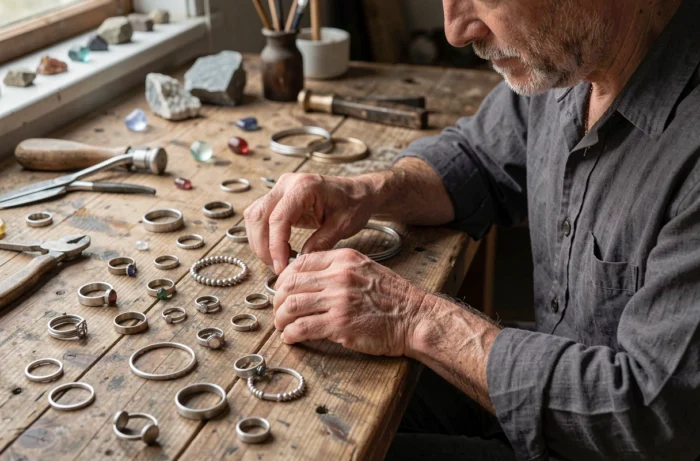
The metal of a piece of jewelry directly interacts with the undertone of your skin. This undertone (warm, cool, or neutral) determines whether yellow gold, rose gold, silver, or white gold enhances your appearance or leaves you looking dull.
- Warm undertone (greenish veins on the wrist, skin that tans easily): yellow gold and rose gold create a natural harmony. Pure silver may appear too cool and create an unflattering contrast.
- Cool undertone (bluish veins, skin that reddens in the sun): silver, platinum, and white gold are more suitable. Highly saturated yellow gold can clash.
- Neutral undertone (a mix of green and blue veins): most metals work. This is the most permissive case for mixing jewelry colors in the same outfit.
This principle also applies to stones. A diamond set in white gold produces a very different sparkle than the same diamond set in rose gold. The metal alters the perception of the stone as much as the stone itself.
The Case of Rose Gold
Rose gold contains copper, giving it its warm hue. It adapts to a broader range of skin tones than classic yellow gold. On fair skin with a cool undertone, it adds warmth without the excess of yellow gold. On darker skin, it creates a soft contrast that highlights the jewelry without washing out the complexion.
Necklaces and Neck Morphology: Length and Volume
The length of a necklace modifies the vertical line of the bust. A choker visually shortens the neck, which suits long, slender necks but weighs down a short neck. A long necklace elongates the silhouette and draws the eye to the center of the bust.
The diameter of the neck determines the style of necklace more than current trends. A fine pendant on a long chain slims a wide bust. An accumulation of short chains adds volume to a narrow neckline. A common pitfall: choosing a necklace for its design without checking its worn length, which varies by morphology.
For high-neck or boat-neck outfits, the necklace should extend beyond the garment’s line to remain visible. With a V-neck, a pendant that follows the same V line creates a geometric repetition that structures the gaze.
Rings and Hand Proportions
The ring is the piece of jewelry most exposed to daily scrutiny, and hands are rarely neutral: long or short fingers, wide or slender, nails worn short or long. Each parameter influences how a ring looks.
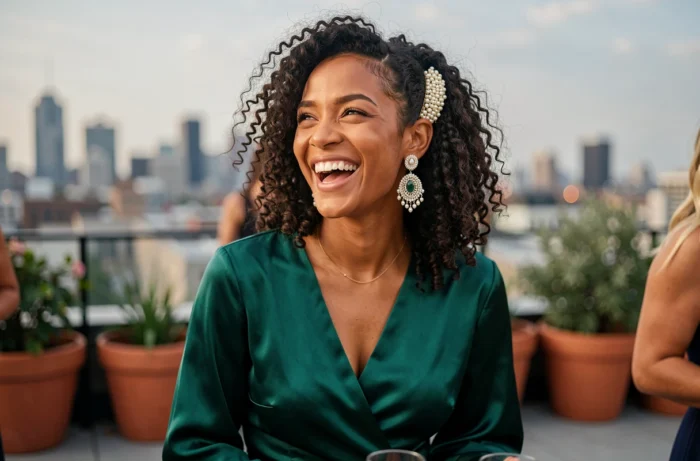
Short fingers gain apparent length with fine rings featuring vertical settings (oval, marquise stones). Long fingers can support wide rings, signet rings, or models with round stones without looking overloaded. A ring that is too wide on a slender finger overwhelms the entire hand.
Accumulation of Rings: Basic Rules
Accumulation works when the pieces share a common element: the same metal, the same band thickness, or the same family of stones. Mixing three different metals without a visual link results in a cluttered look. Two to three rings per hand are sufficient to create a stylish effect without overwhelming the eye.
Jewelry Personalization: A Fundamental Trend
The global market for personalized jewelry was valued at $42.1 billion in 2024, with an expected annual growth rate of 7.5% until 2033 according to Verified Market Reports. Personalization is no longer a niche service but a structuring segment of the market.
Engraving, choice of stone, selection of metal, size adjustment: these options allow for the creation of pieces that match specific morphological criteria rather than a standard. A bracelet adjusted to the millimeter falls differently than a one-size-fits-all model, and this difference is noticeable.
This segment also concerns men’s jewelry, which has long been limited to watches and wedding bands. Clasp bracelets, engraved signet rings, and personalized pendants have established themselves as full-fledged markers of masculine style, supported by data from the Francéclat Observatory noting an increase in the men’s section of French jewelry.
The choice of a piece of jewelry benefits from being treated as a question of proportions, materials, and coherence with your morphology. Trends come and go, but a piece of jewelry well-proportioned to your body remains always relevant. It is this fit between the jewelry and the person wearing it that produces the desired effect, much more than the value of the metal or the price of the stone.