
When preparing a slideshow for a child’s birthday, the choice of tool determines everything else: editing time, creative possibilities, ease of collecting photos from family. Comparing the available options before diving in helps avoid wasting an entire evening on unsuitable software.
Birthday slideshow editing tools: format comparison
Three main categories of tools coexist, each with very different constraints and advantages depending on the parent’s technical level and the desired outcome.
| Type of tool | Examples | Family co-creation | Birthday templates | Direct sharing |
|---|---|---|---|---|
| Desktop software | SmartSHOW 3D, iMovie | No (one editor only) | Yes | File export |
| Online platform | Clipchamp, Canva | Yes (shared link) | Yes (animated text, stickers, GIFs) | WhatsApp, social media |
| Collaborative presentation | Google Slides, PowerPoint online | Yes (simultaneous editing) | Limited | Viewing link |
Online platforms like Clipchamp offer a guided workflow that combines images, video clips, cinematic transitions, and animated text in templates designed for birthday videos. This type of process significantly reduces editing time compared to traditional desktop software.
On the other hand, software installed on a computer offers finer control over 3D effects and music synchronization, which matters if the slideshow exceeds thirty photos.
Before choosing, the first step remains to know how to create a slideshow for a birthday from sorting photos to the final rendering.
Co-creating the slideshow with the child: an underestimated creative lever
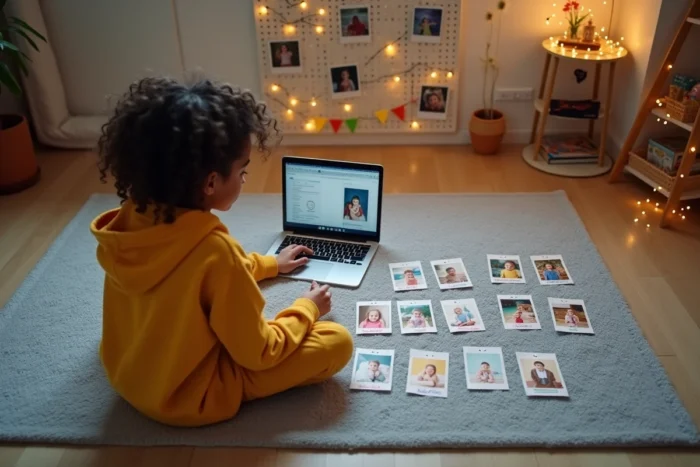
Most guides describe a slideshow made by the parents, projected as a surprise. The reverse approach, where the child participates in choosing photos and narrating, produces a more personal result and turns preparation into a full-fledged activity.
What the child can do according to their age
- From four or five years old, they can point out their favorite photos on a screen and dictate a caption that the parent then types.
- By seven or eight years old, they can drag and drop images into an online tool, choose a sticker or GIF, and rearrange the order of the slides.
- From ten years old, they can independently manage a simple edit on Clipchamp or Canva, including adding recorded voiceovers via webcam.
This co-creation stimulates the child’s creativity on a daily basis and gives them an active role in the party, rather than remaining a spectator of the adults’ editing.
Collaborative photo collection: avoiding the bottleneck
The main obstacle to a successful birthday slideshow is not the editing. It is collecting photos from loved ones, often scattered across phones, tablets, and old computers.
Google Slides or PowerPoint online solve this problem with a shared editing link: each guest uploads their photo to a dedicated slide and adds a caption if they wish. The parent then reviews to harmonize the layout.
With a video editing platform, the method differs. It’s better to create a shared folder (Google Drive, iCloud) where everyone uploads their files, then import the batch into the editor. Setting a submission deadline at least a week before the party avoids last-minute reminders and allows time for sorting.
Sorting photos: the rule of immediate memory
Keep only the images that trigger a specific memory in less than two seconds. A blurry photo of the child laughing is better than a technically perfect posed portrait. The slideshow tells a story, not a catalog.
For a birthday, about twenty well-chosen photos are enough for a three to four-minute slideshow. Beyond that, the attention of young guests wanes.
Scripting the birthday slideshow: structure and projection rhythm
A slideshow without a guiding thread resembles a randomly flipped album. Three narrative structures work particularly well for a child’s birthday.
The chronological structure, from birth to the day of the party, remains the most readable. It works especially well for significant birthdays (one year, five years, ten years) where the contrast between old and recent photos creates emotion.
The thematic structure groups photos by themes: vacations, school, family moments, mischief. It is better suited for older children, who appreciate the surprise effect when an unexpected category appears.
The “quiz” structure intersperses questions between the photos (“Who remembers this day?”, “Where was this photo taken?”). It turns the projection into a collective game and keeps the guests’ attention much longer than passive scrolling.
Music and voiceover: two choices that change the tone
Adding a song that the child loves anchors the slideshow in their universe. Clipchamp and SmartSHOW 3D allow for synchronizing transitions with the musical rhythm, resulting in a smoother output than simple fixed timing per slide.
The child’s voiceover commenting on their own photos produces a more touching effect than a generic soundtrack. Recording via webcam integrated into certain online platforms simplifies this step.
Projection on the day of the party: practical constraints to anticipate
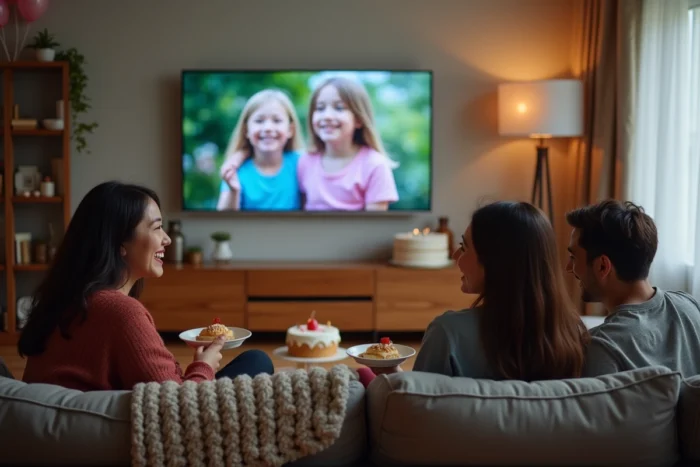
The best slideshow in the world misses its effect if projected on a gray wall in bright sunlight. Planning for a white wall or a stretched sheet in a room that can be darkened is sufficient in most cases. A portable projector connected via Wi-Fi avoids cable issues.
For an outdoor party, projection on a screen only works at dusk. The alternative: play the slideshow in a loop on a tablet placed on the snack table, in vertical format, without sound.
Exporting the final file in two formats (MP4 video for projection, sharing link for invited parents) ensures that each family leaves with a memory. This double export takes a few minutes and transforms the slideshow into a lasting gift, well beyond the party itself.